World Anti-obesity Day: Are you fat when you drink water? You need to know these truths about obesity.

May 11th is World Obesity Prevention Day. With the improvement of living standards, more and more people begin to pay attention to obesity and care about how to lose weight scientifically. In this issue of "One Minute Health Course", Zhou Zhiyi, director of the General Medicine Department of Chongqing People’s Hospital, explained the relevant knowledge to everyone.

Many netizens report that they eat very little, but they are still very fat, and teasing themselves to drink water will make them fat. Does this easy-to-fat constitution really exist? Zhou Zhiyi said that in addition to diet, there are four important factors that affect weight.

First of all, basal metabolism accounts for more than 70% of the total consumption in a day. When basal metabolism is relatively low, it is easy to get fat;

Second, when the body fat rate is high, low metabolism is also easy to gain weight;

Third, hormone levels will also affect weight, such as insufficient thyroid hormone levels, low metabolism, and easy to gain weight;

Fourth, when active exercise is insufficient, passive exercise is also reduced, and it is easy to get fat when consumption is less than intake.

So, how do you judge whether you need to lose weight? Zhou Zhiyi suggested that there are three indicators to judge obesity. First, the body mass index, divided by the square of height, is normal at 18.5 to 23.9, overweight at 24 to 27.9, and obese at more than 28; The second is waist circumference, which is greater than 90 for men and 85 for women, belonging to abdominal obesity; The third is the body fat rate. When the male body fat rate is more than 25% and the female body fat rate is more than 30%, it also belongs to obesity.

Finally, Zhou Zhiyi reminded everyone that to lose weight healthily, it is necessary to develop a healthy lifestyle, keep your mouth shut, spread your legs, and ensure a balanced diet when maintaining a healthy weight, so that you can achieve healthy weight loss without rebounding.

Click on the picture below to enter 【1 minute health class] topic, get more.Wonderful content

↓↓↓

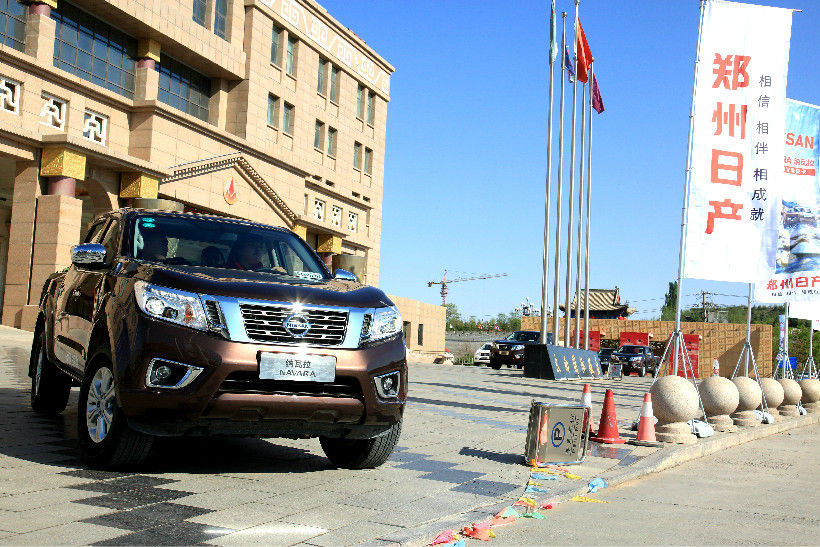
The New Choice of Pickup Party —— Test Drive of Zhengzhou Nissan Navarra

Sometimes, simple liking can make you break away from the shackles, because I believe that smart people can always read themselves and choose the life they want most. Follow the big army without thinking, and you can only drift with the tide and finally lose yourself. Perhaps, it’s no wonder that others are blamed for forbearing their own tastes, isolating themselves from the few pleasures left in the world, and passing by the best. Lack of courage can be cultivated slowly. Without a reliable "partner", it is a great regret in life.

amsCar review drivingEvaluation:★★★

Advantages:The design is atmospheric, the seat is comfortable and the response is fast. 

Disadvantages:The allocation of science and technology is few, the motivation in the later stage is soft, and the policy is limited.

Time to market:June 2017

estimatePrice:139,800-186,800 yuan

Competing models:

China market analysis:Due to the policy limitations, perhaps individual front lines are not the main sales battlefields of this type of vehicles, but the situation is completely different for those with more complicated road conditions and close geographical location to the west or mountainous areas. On the cargo carrying capacity, the advantages of vehicle types are obvious. In addition, it is still a new school that is close to the middle and high grade in terms of design, workmanship, riding and driving. In this way, adding an additional score that can be added seems to be a bright future.

In fact, before each test drive, my heart is full of mixed feelings, especially when I face the challenge directly. I need some time to get used to it. I need to build a good trust with you. I am looking forward to whether my driving habits and temper can get along well and successfully complete this task of crossing the desert.

Get off the plane, take the bus, check in, and I’ll go back to the hotel square. Placed in the center, a quiet stop, rest, seems to have just finished a full day. It’s legs up, flowing with fine sand, and its fearless face, which is bound to step over mountains and rivers, still makes me remember it deeply until now.

Yes, there is every reason to be proud. The history of nearly 84 years tells the story of the years of strength. In addition to well-known engineering vehicles such as D21 and D22, which travel around the country day and night, it is already the twelfth generation product.

In particular, its naming method, although the official said that the new name was inspired by the name of an autonomous region in northern Spain, meaning to experience high-end fashion and inherit classics, but in fact, when I just got its name, I actually thought of the famous Cuban revolutionary and politician ernesto guevara, the spirit of facing difficulties and taking risks, and the tough feeling with a beard and blood.

Let’s talk about the first impression of appearance. Actually, it’s not as hard as I thought. The typical family-style "V-motion" front face is full and solid. The design is not too radical, not grandiose or muscular.

Generally speaking, this is a big brother next door who looks very trustworthy and reliable. Under the front of the car, energetic eyes are still very advanced and practical in this level of market. Perhaps it is this kind of approachable simplicity that leads to the sharp contrast between the strong off-road performance and the appearance, which is unbelievable.

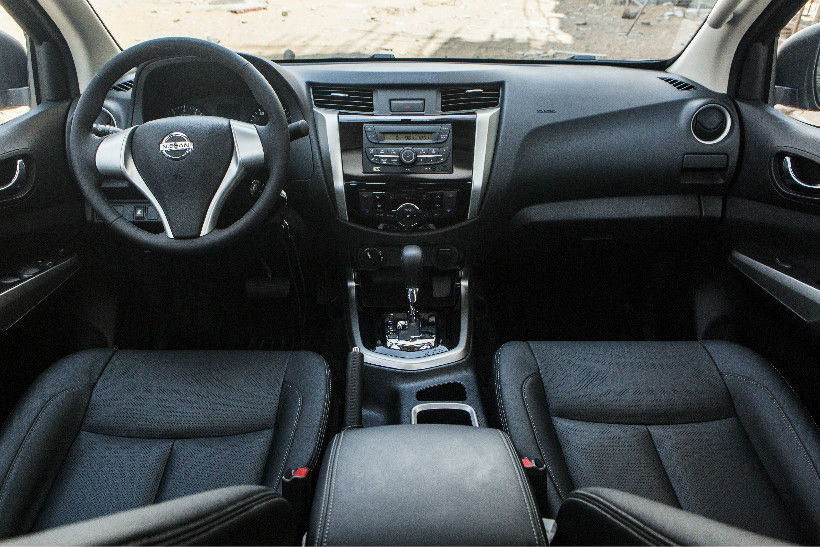
In my inherent impression, your character is quite rough and informal, so as early as the beginning of the test drive, I, a pseudo-perfectionist, didn’t care about your interior workmanship. Who knows, sitting in the car, the sense of exquisiteness is moving. First of all, the car has not been attacked by any peculiar smell, which shows that the materials used are exquisite.

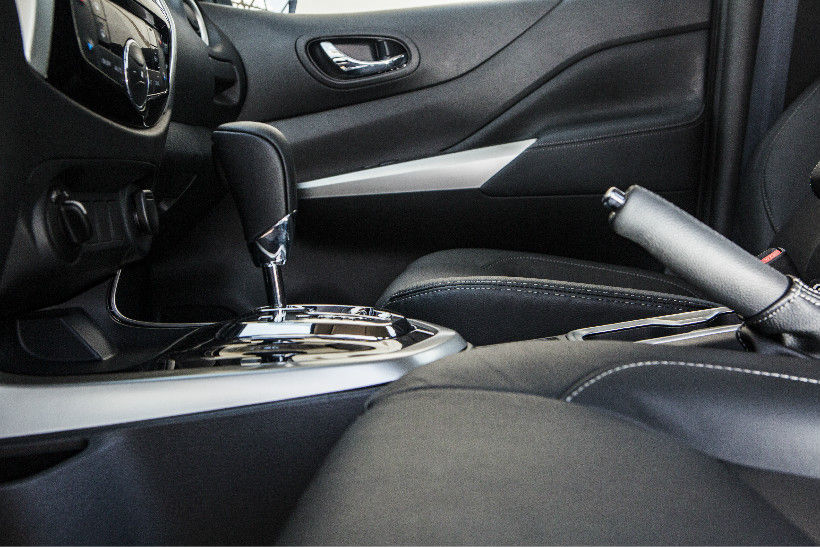
In addition, the design of the center console is also simple and generous, and the regular functions are distributed at a glance. It is not a problem that the buttons are patchy and easy to operate, but the USB port does not support music playback in the iphone, which is not very humanized.

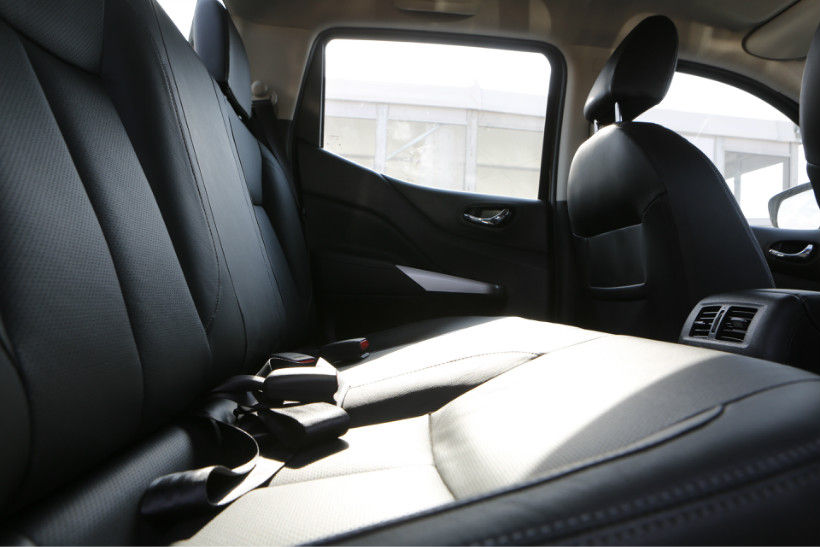
At first, I was arranged in the back row of the car to take a group photo and start the car, so I felt whether the ride experience was proper or not. In terms of size, its length, width and height are 5263mm, 1850mm and 1808mm respectively, reaching 3150 mm. After adjusting the personal habit of sitting, the softness and hardness of the rear seat have been affirmed by me, and the lateral width of the cushion is sufficient. Even if the hip size is large, there is no feeling of being exiled by the cushion.

However, for this class or product, the short rear seat cushion is a disease, and this one can’t escape from it, and the disadvantages of leg support are highlighted. At this time, the knees and calves need strong support for the thighs. Long-term suspension will make the legs feel a little sore, even for friends with strong calf muscle tolerance. For the growth of the imperial city, I am good at using the "paralysis" sitting posture.

Driving on asphalt pavement, the sound insulation and noise reduction level is beyond my expectation. Wind noise and tire noise can match the sedan models of high-end brands. Please forgive the slightly defective noise. After all, this is a proper tonality, and it is not too noisy to be disgusting.

After nearly ten kilometers, I was transferred to the driver’s seat. It was not the activity rules, but the bouncing feeling in the back row that really made me unbearable to eat too much breakfast. The bonus of driving ahead of time is all thanks to the post-independence with girders. For the undulating asphalt pavement, the feedback is very sensitive and obvious, which is exactly the case, so that I can feel the driving experience of this machine early.

The steering wheel feels good, but the steering needs the strength of the handle. Although the accuracy is slightly blurred, the feedback strength still has a sense of communication with the driver. The accelerator pedal is finely tuned, the power does not jump, and the acceleration smoothness is easy to control. However, the effect is a short board, and the force will be more obvious when you step on two-thirds of it. By the way, the car at this moment is fully loaded (with an average weight of 80 kilograms) and the trunk is equipped with a counterweight sandbag weighing 200 kilograms, plus its own weight, please calculate it yourself.


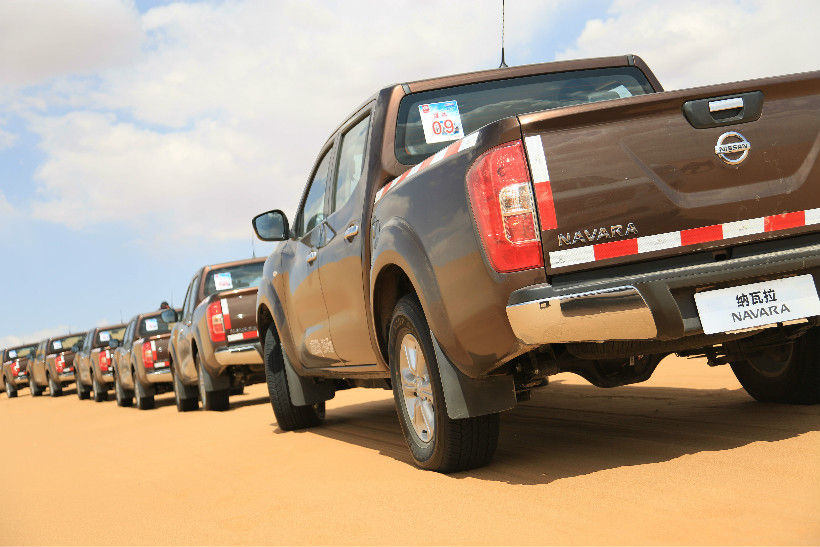
As the sandbar in front of me got closer, I didn’t consciously put on my swimming trunks. Instead, I clutched the steering wheel and tightened my thighs at a loss. Here is the famous Tengger Desert, one of the venues for the activities of Alashan Heroes’ Club. The barren and shocking sand dunes are far more difficult to drive than everyone imagined, so that accidents and accidents are recorded every year.

Can this 2.5L naturally aspirated machine, code-named QR25, meet the desert challenge? I am puzzled, even though I quite approve of this one’s good performance in brand-new and superior models. Subsequently, the slightly different data were adjusted and the vertical layout rearranged to match the four-wheel drive system calmed my panic a little. It was not until I learned the model and the data of this 184,251 Nm again that my uneasy heart eased.

Yes, this is the 7-speed automatic manual from JATCO. The electronic control system carried by the car is also assembled on the famous Y62, which is famous for its strong off-road ability.

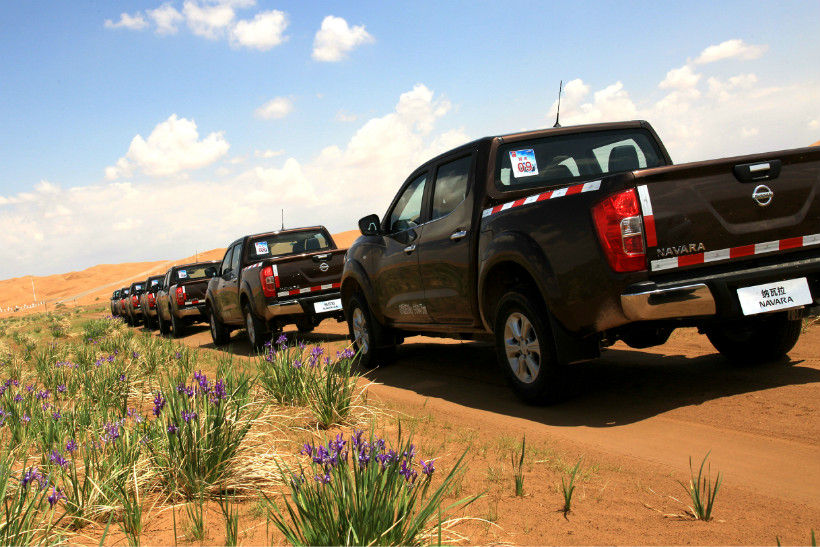
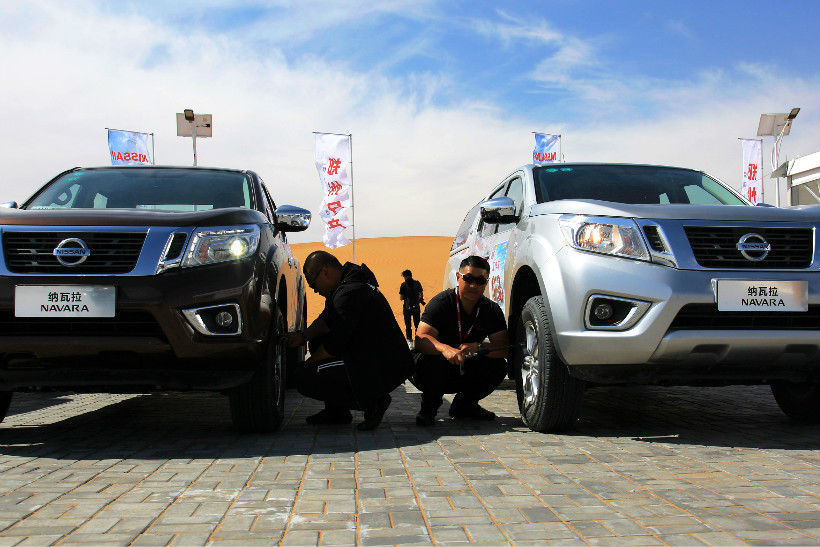
Xiao Xu, who can’t wait after lunch, has been quietly put to 1.3bar, switched from two-wheel drive mode to high-speed four-wheel drive, and the team drove into the desert center. In the yellow sand-filled environment, people who lack sand driving experience will not be able to accurately and calmly judge the current sand situation except the rut marks of the preceding car. At this time, a high enough speed and the initial speed of each slope are particularly important, and this action is also the usual skill of sand driving. At this time, don’t forget that there is a maximum ground clearance of 218mm, which will become a powerful guarantee for frequent slope washing.

In addition, 31 degrees and 26 degrees will also fully improve the off-road limit. What should I do if I slip or get stuck? Be sure to remember, don’t turn the steering wheel greatly, which will lead to the loss of power in vain. If it is in an irreparable situation, don’t blindly and excessively take a big throttle to get out of trouble. It is not only futile, but also deeper and deeper. The last thing waiting for you is the embarrassment that you can’t extricate yourself and get out of trouble by yourself.

To tell the truth, before crossing the desert, I didn’t approve of the ride comfort, but when the team traveled to the road surface full of fine sand and gravel, the up-and-down tremor and left-and-right swing of this machine were controlled quite well, and it could even run like a car driving on the asphalt road. Coupled with the electric control four-wheel drive system that works in time, whether it is hump road or side break, and then to "cutting the blade" and "washing the casserole", it is so full of fun that people are still wanting.

Ams car review

What is the concept for most consumers in China? In what form does it exist? Is it just a simple transport vehicle? Obviously, today’s experience made me understand that what is in front of me is to subvert all this. Regardless of the styling design for the time being, it is almost the same as the most popular model in China market, only this is different from the traditional concept. In addition, the multi-dimensional consideration from comfort, exquisiteness to quality is also the characteristic of completely jumping out of the tool.

But unfortunately, at present, in China, there are indeed too many rules and regulations that are not very friendly to models. If the policy is suddenly released one day, will you feel regret for your holding money for purchase? After all, the price of less than 200,000 yuan can buy a class that is truly off-road and full of driving pleasure. If you buy it, you will earn it! In addition, there is no need to be bound by many front-line policies. It’s a big deal not to enter the Fifth Ring Road. Who dares to go to Jinshui Bridge if he has nothing to worry about? Those are big shots, and we are just ordinary people. It’s best to be happy, don’t you think? "

engineering data

2.5LAutomatic four-wheel drive version

The length is 5263mm, the width is 1850mm, the height is 1808 mm, and the height is 3150 mm. The dimensions of the container are 1510mm, 1562 and 475mm, and the volume of the fuel tank is 73 L and 1791 kg.   

2.5 liters, straight 4, naturally aspirated, 135 kW(184 PS), 251 N m.    

System:Front, front wheel four-wheel drive, 7th gear.  

The front and rear styles are not independent, and the front and rear drums are 255/70 R16. 

Driving performance:0~100km/h -s, 165km/h, - L/100 km

Estimated selling price:179,800 yuan 

Text/Xu Boxuan

Study and implement the spirit of the 19th National Congress and hold high the ideological torch leading the new era.

  Commentator of this newspaper

  Socialism with Chinese characteristics Thought of the Supreme Leader in the New Era is a scientific truth that has been proved by practice, the crystallization of the practical experience and collective wisdom of the Party and the people, the latest achievement of Marxism in China, and a historic leap of Socialism with Chinese characteristics Theory. The 19th National Congress of the Communist Party of China established Socialism with Chinese characteristics Thought, the supreme leader in the new era, as the guiding ideology that the Party must adhere to for a long time and wrote it into party constitution, which has great political, theoretical and practical significance. Standing at the starting point of the new journey, the urgent task is to thoroughly study and understand the supreme leader’s Socialism with Chinese characteristics Thought in the new era, arm his mind, guide practice, implement it in the whole process of socialist modernization and embody it in all aspects of party building, and provide a strong ideological guarantee and spiritual strength for winning the victory of building a well-off society in an all-round way and winning the great victory of Socialism with Chinese characteristics in the new era.

  During the historic period of change, at the crucial juncture of winning the career, the Communist Party of China (CPC) people can always assess the situation, make scientific judgments on the situation and give profound answers to the propositions of the times, and condense into great ideas that guide the future development direction. Especially since the 18th National Congress of the Communist Party of China, in the face of profound changes in the world, the people of the Communist Party of China (CPC), with the Supreme Leader as the main representative, complied with the development of the times, systematically answered the important issues of what kind of Socialism with Chinese characteristics and how to uphold and develop Socialism with Chinese characteristics in the new era from the combination of theory and practice, created the Socialism with Chinese characteristics Thought of the Supreme Leader in the new era, and realized the Party’s guiding ideology to keep pace with the times again.

  Great thoughts stem from great practice. In the past five years, the CPC Central Committee with the Supreme Leader as the core has made innovations and faced difficulties, kept the quasi-social pulse in finding problems, understood the development law in solving problems, constantly broke through the difficulties of reform and development, and successfully responded to various risk challenges. From promoting the overall layout of "five in one" as a whole, to coordinating the promotion of "four comprehensive" strategic layout, and then to implementing five new development concepts … … A series of new ideas, new ideas and new strategies put forward in economic construction, political construction, cultural construction, social construction and ecological civilization construction have formed a closely linked and interconnected system of ideological theories and policies, which have gradually sublimated into Socialism with Chinese characteristics Thought of the Supreme Leader in the new era, leading the whole party and people throughout the country to achieve a series of major historical achievements and changes.

  Great ideas come from great innovation. Closely combine the basic principles of Marxism with the reality of contemporary China and the characteristics of the times; Deepen the understanding of communist party’s ruling law, socialist construction law and human social development law with a new vision … … Through arduous theoretical exploration and practical innovation again and again, Socialism with Chinese characteristics Thought, the supreme leader in the new era, has answered a series of basic questions of adhering to and developing Socialism with Chinese characteristics in the new era with "eight explicits", and formed the basic strategy of adhering to and developing Socialism with Chinese characteristics in the new era with "fourteen adherences", inheriting and developing Marxism–Leninism, Mao Zedong Thought, Deng Xiaoping Theory, Theory of Three Represents and Scientific Outlook on Development, and opening up a new realm of Chinese Marxism development in the 21st century.

  The new journey of the new era cannot be separated from the correct guidance of scientific theory for a moment. Socialism with Chinese characteristics Thought of the Supreme Leader in the New Era is the ideological torch leading the new era and the beacon guiding the correct direction. From now until 2020, it is the decisive period for building a well-off society in an all-round way; From the 19th National Congress to the 20th National Congress, it is the historical intersection of the goal of "two hundred years". Our generation has a long way to go to strive for the long March in the new era. At present, an extremely important task is to study, publicize and implement the Supreme Leader’s Socialism with Chinese characteristics Thought in the new era, never relax and strengthen the theoretical arm, and enhance the consciousness and firmness of studying, publicizing and implementing it. We should not only deeply study the background, theoretical origin, practical foundation and rich connotation of the important thought, but also apply the Marxist standpoint and method contained in it to all the work and links of reform, development and stability, so as to do great things, solve difficult problems and open up new opportunities, better uphold, defend and develop Socialism with Chinese characteristics, make concerted efforts to carry out great struggles, build great projects, advance great undertakings and realize great dreams, and strive to create new victories and dreams in the new era.

On the advantages and disadvantages of Chinese by comparing languages of different countries

Computer keyboards have 26 English letters, and the preferred language for computer software and website development and operation is English. The popularity of the Internet has further consolidated the status of English as an international common language, which makes other languages feel pressure. Although Chinese has the largest population, it has a low degree of internationalization, and there are far fewer countries that use Chinese and use it as a second language than English-speaking countries. There are many sayings about the backwardness of Chinese and the alphabetization of Chinese characters. It seems that the foundation of our China culture is dying.

This is a superficial understanding of China’s backwardness and beatings in modern times. A comprehensive comparison of languages in various countries will show that Chinese is not only backward, but also the best language in the world: Chinese characters are standardized and beautiful, with many elements of word formation, many ways of word formation, flexible word formation and word formation, rich syllables, large language capacity, simple grammar and fast and clear expression.

According to Wikipedia’s statistics on the major languages in the world, this paper takes Google Translation as an example: "Why don’t they speak X?" Look at the glyphs of the characters in major languages, analyze the composition of the characters, and analyze the phonetic syllables to compare the major languages, so as to identify the advantages and disadvantages of Chinese:

The number of native speakers in countries with phonetic syllables composed of language examples

Chinese Jane: Why don’t they speak Chinese?

Why don’t they speak Chinese? Nearly 200 pictographs and more than 800 phonemes can be combined into words, and words can express meanings. 23 initials ×33 finals =759 ×4 tones =3036 syllables, and the actual number of syllables with tones is 1315. Sino-Tibetan Language Department, China, Singapore and Malaysia, 1.1 billion.

Why can’t they just speak English? 26 letters, only the left and right structures can be combined to form a word meaning, but not the upper and lower ones. phonography has 28 consonants and 20 vowels, with a maximum of 560 syllables, and actually uses about 400 syllables. Indo-European languages, Britain, the United States, Canada, Australia and India, etc., with 330 million, are the most widely used international lingua franca.

Spanish ?Cómo que no hablan espa?ol? 29 letters, only left and right one-dimensional combination, phonography is clumsy in meaning. New words are frequent and have poor stability. 24 consonants, 5 vowels, up to 120 syllables, Indo-European family, Spain, Latin America, 300 million, the second international lingua franca.

Indy/Urdu has 44 letters, which can only be combined left and right in one dimension. The font is irregular, ugly and difficult to write and recognize. There are 11 vowels and 43 consonants with a maximum of 473 syllables, so it is not bad to use half the syllables actually. Austronesian family, India, Pakistan, United Arab Emirates, Bahrain, 500 million, low degree of internationalization.

There are 28 letters in Arabic, which can only be combined in one dimension, and the font is irregular, which is ugly and difficult to write and recognize. There are 28 consonants and 12 meta-phonetic symbols, with a maximum of 236 syllables, and the actual use will not reach 236. Non-Asian languages, 200 million people in the Middle East and North Africa.

Bengali is not displayed. Look at the picture:

51 letters, only left and right one-dimensional combination, irregular font, ugly and difficult to write and recognize. 11 vowels, 40 consonants, with a maximum of 440 syllables. austronesian family, Bangladeshi and Indian 185 million.

Portuguese porqueeles no falam portuguê s? 23 letters, can only be combined left and right, can’t combine five vowels up and down, namely a,e,i,o,u, and there are 18 consonants, with a maximum of 90 syllables in Indo-European languages, Portugal, Brazil, Angola and Mozambique, 160 million.

Russian почемуониеговорятна?. 33 letters can only be combined in one dimension. phonography is easy to read, but clumsy in meaning. Among them, there are 10 vowels, 21 consonants and 2 silent symbols, with a maximum of 210 syllables. Indo-European Slavic Language Family, Russia, Belarus and other Russian Federation countries, 160 million.

Japanese なぜらはがせなぃのですか? Square Chinese characters are mixed with cursive scripts of hiragana and katakana, and there are 50 hiragana and katakana, which are neither fish nor fowl, and the syllables used are more than 100 Altaic languages, with 125 million in Japan.

German warum sprechen sienicht einfach Deutsch? 30 letters can only be combined in one dimension. phonography is easy to read but clumsy in meaning. There are 11 vowels and 23 consonants, with a maximum of 253 syllables, and fewer syllables are actually used. Indo-European language family, Germany, Austria, Belgium, Italy and Switzerland, 100 million

French pourquoi, tout simple, neparlent-ils pas franais? 26 letters, only left and right one-dimensional combination, phonography ideographic clumsy. 7 vowels, 20 consonants, up to 140 syllables. Indo-European language family, France, Canada, Belgium, Switzerland and Haiti, 75 million.

Korean? 40 letters, two-dimensional combination, phonography is clumsy in meaning. 21 vowels and 19 consonants, with a maximum of 399 syllables. Altaic language family, South Korea and North Korea, 60 million.

Thai? 76 letters, only left and right one-dimensional combination, ugly and difficult to write and recognize. There are 44 consonants, 32 vowels and 5 tones. There are 7040 syllables, and the pronunciation is simple. South Asian language family, Thailand, 50 million, low degree of internationalization.

Advantages: 1. Chinese characters are regular and easy to recognize. The glyphs of English, Spanish, Portuguese, Russian, German and other alphabet languages are mostly round, with few strokes but difficult to recognize. The English, Spanish, Portuguese, Russian, German and other alphabet symbols lack the function of pictographic meaning, and their semantic symbols-words are a combination of a few letters, which are prone to alexia. The glyphs of Chinese characters are square characters, and the glyphs have the function of pictographic meaning. The number of alexia patients in Chinese is the lowest in the world.

Indi-Urdu, Arabic, Bengali

The characters of languages such as Thai and Thai are very irregular, ugly and difficult to write and recognize, and their inherent defects greatly hinder the interest in learning these languages. In the wave of language internationalization, these languages will be eliminated and marginalized more and more.

Korean characters are also square characters, but they belong to phonography. Like English and other alphabet languages, phonography is easy to read and clumsy to express meaning, and Korean characters are difficult to recognize, and many people suffer from Korean alexia.

Japanese is a mixture of square Chinese characters, Hiragana with Chinese strokes and Katakana with Chinese cursive script, which is quite a mixture of block letters, running script and cursive script. It is neither fish nor fowl. If it is not the reason of Japan’s developed economy, there are not many people who are interested in learning Japanese.

In typesetting, letters and characters can only be arranged horizontally but not vertically, which is not as flexible as Chinese typesetting.

Advantages 2. Chinese characters have many elements and ways of word formation, flexible word formation and word formation, large language capacity and good stability.

The radicals of Chinese characters are equivalent to letters, and a single Chinese character is equivalent to words. A Chinese character takes up less space than a word, and there are more than 1,000 Chinese character-building parts, including 200 beside the shape of meaning and 800 beside the sound of sound (the "List of Parts of Modern Chinese Commonly Used Characters" published by the State Language Committee has 512 parts, but this list does not exhaust all Chinese character parts). In other languages, there are few word-forming elements: 26 English letters, 26 French letters, 29 Spanish letters, 23 Portuguese letters, 29 German letters, 44 Hindi letters, 28 Arabic letters, 33 Russian letters and 40 Korean letters … How can such few letters compare with the word-forming elements of Chinese characters?

There are more word-formation ways of Chinese characters than alphabetic languages. Alphabetic languages such as English, Spanish, Portuguese, Russian, German, French, Arabic and Indian can only form ideographic symbols-words with left and right structures, but not with upper and lower structures, and the number of word-formation letters is small, which will inevitably lead to long words. In addition to left and right word-formation, Chinese characters can also form words with up and down, up and down, left and right sets of up and down. Chinese characters can be easily combined into 200 * 800 * 2 = 320,000 Chinese characters by four ways: left and right, up and down, up and down, left and right, and up and down. In fact, in order to avoid confusion, Chinese characters are rarely combined with repeated radicals, and only one of them is selected for combination once. If you have nothing to do with composing Chinese characters, you will find that a large number of radical combinations are not used, which leaves a broad space for the transformation of Chinese characters. If the number of English letters increases by five times to 130, the number of English vocabulary combinations will be five times larger, and the thickness of English dictionary will be much smaller. Even so, compared with more than 1,000 radicals and two-dimensional combinations in Chinese, English is still far behind, and other alphabet languages are similar. Chinese has a large capacity, and there is a lot of room for transformation and upgrading, so there is no need to overthrow it.

Alphabetic language is one-dimensional boring password information, Chinese characters are two-dimensional pattern information with integrated form and sound, and the expressive function of English letters is very weak. English letter combination is coding, while reading English is decoding. Although the alphabet language is easy to learn at first, it is not easy to learn fine because of its huge word system.

Two-dimensional Chinese makes the best use of plane space. Many Chinese characters are just a picture. Who can read the information from the picture faster than the information from the password? In Anglo-American society, patients suffering from "alexia" can’t read and write English, which is ultimately caused by the one-dimensional cryptology of English, but there is no "alexia" in the Chinese world. The expressive force of Chinese characters makes reading very convenient, so we can capture its characteristics and map its meaning at a glance. One-dimensional string cipher pinyin characters can’t do this anyway.

Pinyin has sacrificed its ideographic ability, resulting in its non-intuition. Alphabetic language is a symbol of sound, a low-level form of words, and a one-dimensional password. Two-dimensional Chinese characters are 80% pictophonetic characters, and pictophonetic characters express sounds and meanings. This combination has the greatest expressive power that plane space (paper) can give, which is undoubtedly superior in information expression. The two-dimensional nature of Chinese characters determines the diversity and flexibility of their input methods, which is far more inspiring than the "one-dimensional" password-based pinyin language, while the foundation of alphabetic language is not good, and it is difficult to improve it without completely reinventing it.

In the face of knowledge explosion, Chinese can cope with it easily, while English and other alphabetic languages are tired of it. English, Spanish, Portuguese, Russian, German, French, Japanese and Korean languages should constantly invent new words to adapt to new things, such as Rockets, Computers, Cinema, etc., but Chinese does not need to invent new words, just need to combine words into new words. Isn’t "rocket" an arrow driven by "fire" and "computer" a human brain that uses electricity? The "cinema" is just a "courtyard" where "electricity" is used to cast "shadows". But English can’t be combined like this, otherwise it will be "too long". For example, the rocket group will become "Fire-Driven-Arrow", the computer will become "Computational-Machine" and the cinema "hall-where-to-see-shade-projected-by-electivity" and so on. If you have to combine words to achieve your goal without increasing the length, you can only rely on abbreviations, such as taking the prefix HWTSSPBE to represent the above-mentioned cinema phrase. There are a lot of incredible abbreviations in English. People’s perspective is limited, and too long words will reduce the readability of the article and the reader’s understanding ability.

Chinese can easily deal with similar things, but English coinage is often a new and unrelated symbol, such as pork pork, mutton mutton, beef beef, lard lard lard, sheep oil suet and butter talon. This is how hundreds of thousands of words in English come from. The English dictionary is much bigger and thicker than the Chinese dictionary, and the English vocabulary has exceeded 400,000. It is expected that the spread will exceed 1 million in the middle of the next century, and the 11,200 Chinese characters in Xinhua Dictionary will be used for thousands of years.

The stability and continuity of Chinese characters are incomparable to English and other alphabetic languages. Today, it is not difficult for us to read Laozi’s Tao Te Ching. Nowadays, it is difficult for people to read Shakespeare’s original works, not to mention the poems of Chaucer, an English poet 400 years ago.

Advantages 3. Chinese phonetics are richer than alphabetic languages, and the expression is faster, clearer and more powerful. Chinese characters can express meaning with one sound, while words in other languages often have multiple sounds to express meaning. Chinese has more syllables than English.

There are 23 Chinese initials: b p m f d t n l g k h j q x zh ch sh r z c s y w;

There are 33 Chinese vowels: a an ao ai ang o ong ou e en er ei eng i ia iu ie in ing iao ian iang ong u un ua uo ue ui ü n uai uan uang.

23*33=759 syllables. According to the Chinese Pinyin scheme, some initials and finals cannot be combined, but there are actually 415 syllables. If four tones are added, there are 4*415=1660 syllables with tones, and the actual standard pronunciation with tones is 1315.

English has 28 consonants (equivalent to Chinese initials) and 20 vowels (equivalent to Chinese vowels, English long vowels and short vowels are really unnecessary):

English has 560 syllables in theory, but only 400 syllables are actually used. English words need polysyllables to express their meanings (monosyllabic words are rare), while Chinese words only need monosyllables to express their meanings. There are more vowels in Chinese than in English, and English consonants and vowels are more similar and laborious than Chinese initials and vowels. Therefore, Chinese pronunciation is clearer and louder than English. In the simultaneous translation of languages, Chinese is often finished and English is not finished.

Why do the more kinds of sounds, the faster the speed of thinking and expression? Suppose a person can only pronounce two sounds, A and B. If there are only 400 things to be expressed in the world, then the 400 sounds of English correspond to 400 things one by one, and the person who can only pronounce two sounds will have to express one of the 400 things with nine pronunciations, because the nine times of two are only more than 400. For example, the British use’ I’ for’ I’, while people who only have two voices may use abbababba for the concept of’ I’. It takes about 0.25 seconds for an average person to pronounce a sound, and it takes 2.25 seconds for a person who only knows two sounds. This shows that the fewer syllables, the harder and slower the expression. The 400 syllables in English are only one-third of the 1315 syllables in Chinese, which is the reason why Chinese is faster than English and other alphabetic languages. Japanese uses 100 different sounds, while Chinese uses 1315 sounds, so many Chinese characters have to be expressed in two or three sounds when Japanese people read them. We assume that all words in Japanese are expressed by two sounds, that is to say, in the same time, the information that Japanese people hear is only half that of Chinese.

In the comparison table of major languages, only Thai has more syllables than Chinese, and the pronunciation of other alphabet languages does not exceed that of Chinese. Although Thai is rich in pronunciation, it is ugly and difficult to write, which is the congenital defect of Thai, which makes it unable to compare with Chinese. So it seems that it is great for our ancestors to create Chinese characters.

Advantage 4: Chinese grammar is simpler than alphabetic language. Verbs in English, Spanish, Portuguese, Russian, German and French are tense, nouns are plural, such as English. After verbs, we add ing to indicate progressive tense and ed to indicate past tense, which changes the spelling and reading methods of words. Chinese is not so clumsy, and the tense problem is easily solved by using the word "positive" in the progressive and "le" in the past. Chinese nouns don’t have plural numbers, which is not as troublesome as adding an S after nouns in English, and changing F into V when it ends in F, etc.

Some people say that Chinese grammar is simple and phrases and sentences are flexible, which shows that Chinese’s thinking is not rigorous. On the other hand, why make the language so troublesome and rigid? Language is first and foremost a tool, which is powerful, flexible and simple to use. Isn’t it the characteristics that an excellent language should have?

Disadvantages of Chinese

Although Chinese has many innate advantages, it also has shortcomings. The disadvantages of Chinese are as follows:

Disadvantages 1. Chinese is recognized as the most difficult language to learn.

This is the most difficult language ranking in the world according to the statistics of the United Nations Department of Science, Education, Culture and Health:

1- Chinese 2- Greek 3- Arabic 4- Icelandic 5- Japanese

6- Finnish 7- German 8- Norwegian 9- Danish 10- French

Chinese is difficult to learn for foreigners whose mother tongue is alphabetic language. The biggest problem in learning Chinese is the difficulty in getting started. There are more than 200 phonetic symbols and more than 800 phonetic symbols in Chinese, which is much more difficult than getting started in languages with only dozens of letters. Although it is difficult to get started in Chinese, it is easier to learn general knowledge than alphabetic language. The literacy standard of Chinese characters is 1500 words, and college students in science and engineering generally master 2000 Chinese characters. With these 2000 words, everyone can read books, newspapers and engage in scientific research. But in the English-speaking world, you can’t read newspapers without mastering 20,000 words, and you can’t read Time magazine smoothly without 30,000 words. Professionals who graduated from college 10 years ago generally know 80,000 words.

Chinese is more difficult to learn than people with alphabetic languages. In today’s world, most countries are one-dimensional alphabetic languages, and polysyllabic words with less than 50 words are used to express meanings. They have not learned Chinese that can express meanings by two-dimensional combination of single sounds, so it is difficult to learn because the system of complete Chinese is completely unfamiliar. Generally speaking, there are few elements in a thing, and it is easy to get started, but its function is not strong. These are two sides of the same thing. Chinese has the advantages of large information capacity, concise and rapid expression, clear pronunciation and fast expression, which are characterized by many elements, many ways, flexible word formation and word formation, and rich syllables. However, this feature must have its weakness that it is difficult to get started. English and other alphabetic languages have few words. Although it is easy to start, there are a lot of shortcomings behind it. Once they learn Chinese, the accuracy and efficiency of Chinese are more attractive than other languages.

The difficulty of learning Chinese is mainly reflected in:

Chinese characters emphasize meaning over pronunciation, and the pronunciation rules of Chinese characters are destroyed too much. Learning mainly depends on rote memorization. There are too many hidden rules in Chinese, and polyphonic words and transliteration words (pictophonetic words used for different pronunciations by one sound) destroy the pronunciation rules too much, just like there are as many hidden rules in China society. Learning Chinese characters mainly depends on time-consuming and laborious rote memorization, which greatly delays the time of learning Chinese and discourages the enthusiasm of learning Chinese. It takes foreigners several times as long as other languages to learn Chinese well. Letters-based languages are mostly phonetic languages. It is easy for foreigners to learn similar languages, but the rules of Chinese are too broken. It is not only difficult for foreigners to learn Chinese, but it is also difficult for Chinese to learn Chinese well.

The main culprits that break the rules of Chinese pronunciation are polyphonic characters and transliteration characters, which aggravate the complexity of Chinese characters. There are 250 polyphonic characters in common use, so there are more transliteration characters. Transmutation characters are used by a phonetic side for many words with different pronunciations: for example, "yao yao", "jiao Dong" and "rao Rao" all use them, but their pronunciations are different, just like "Yao Yao". Polysyllabic characters and transliteration characters can be eliminated by reforming Chinese characters, so that one character has one sound, and pictophonetic characters have the same pronunciation as phonetic characters. The disadvantages of Chinese rote memorization are also found in alphabetic languages.

Homophones and homonyms are a headache, and the tone is often bad for foreigners. Homonyms can be reduced, but homonyms can’t be eliminated, because there are fewer syllables in Chinese characters, 3,500 commonly used Chinese characters, and 1,100 commonly used Chinese syllables, with an average pronunciation of 3.18 Chinese characters. There is no guarantee that one word can be pronounced, but homonyms can be reduced. The tone of Chinese characters is worried about foreigners, so there is no way. There is no way to change the four tones, so we have to learn to adapt.

Chinese characters are complicated in word formation and have many strokes, which makes it difficult for foreigners who are used to the alphabetic language to write. Some Chinese characters have bloated strokes and even we in Chinese don’t like them, such as:

The cancer-ridden whip is beside the thin Tibetan food, and the pot is filled with a cry, a cry, a cry, a cry, a cry, a cry, a sauce, a cry, a cry, a cry, and a cry.

The structure of these Chinese characters is either upper, middle and lower, left, middle and right, or the left and right structures are nested with upper and lower structures, and the strokes are bloated and repetitive, so it is very necessary to simplify them in the system transformation of Chinese characters.

Disadvantages 2. The degree of internationalization of Chinese is not high. This is the ranking of the number of second language users made by linguist George Weber in 1997:

French (190 million) English (150 million) Russian (125 million) Portuguese (28 million)

Arabic (21 million) Spanish (20 million) Chinese (20 million)

German (09 million) Japanese (08 million)

Chinese is a sad reminder. Only 20 million people regard Chinese as a second foreign language. In the ranking of the number of language-using countries, Chinese is not prominent either:

English (115) French (35) Arabic (24) Spanish (20) Russian (16) German (9)

Mandarin (5) Portuguese (5) Hindi/Urdu (2) Bengali (1) Japanese (1)

Comprehensive influence of major languages:

Chinese has not achieved the corresponding international status at all. One of the reasons is that China’s international influence is far less than that of English-speaking countries, which is the result of long-term despotism in China and China, and the other is that foreigners who have their own system of Chinese find it difficult to learn.

The scripts of China’s neighboring countries, such as Korean and Vietnamese, have been established and standardized in the past 200 years. They are deeply influenced by Chinese, but it is very short-sighted to imitate English and other one-dimensional alphabet languages without exception. When China is developed, will these countries take pleasure in imitating Chinese?

Disadvantage 3. The simplification and simplification of Chinese characters have not been unified, which is caused by historical reasons. Traditional Chinese is used in Taiwan, Hong Kong, Macao and overseas Chinese, and simplified Chinese is used in Chinese mainland. This problem is not too big, and there are similar problems in Spanish. In the near future, after the democratic reunification of Hong Kong, Macao and Taiwan with the mainland, the simplified and traditional Chinese characters will be unified, and a comprehensive reform of Chinese characters will be ushered in, so that the problem of difficult Chinese learning will be alleviated and the internationalization of Chinese characters will be improved.
From fighting the epidemic to fighting the flood, he charged ahead!

Wu Guang is on the Kaotian River levee. Zhang Yifei

It is difficult to interview Wu Guang. On the Kaotianhe levee in Zhuogang Town, Huangmei County, Hubei Province, every time the reporter found him during the break of the officers and men, he always waved his hand shyly and said, "Go interview my comrades-in-arms, they did a great job!"

After several unsuccessful interviews with Wu Guang, the reporter got such a brief introduction from the accompanying cadres: Wu Guang, deputy brigade commander of a pontoon brigade of the Central Theater Army, joined the army for 27 years and participated in ’ Major tasks such as flood fighting in 1998, the rescue of the sunken ship of "Oriental Star", the inspection exercise of "Crossing the Yangtze River -2018" project support, and the support for the opening and closing ceremonies of the 7th military world games.

Yang Jun, the instructor of the Fourth Battalion of this brigade, knows Wu Guang very well. "He usually doesn’t talk much, he is very pragmatic, and his work is resolute." Yang Jun told reporters, "With him, we are very practical."

On the morning of July 8, a pontoon brigade of the Central Theater Army was ordered to go to Huangmei County, Hubei Province to participate in flood fighting and rescue. At this time, the Kaotian reach has exceeded the warning water level, and many places are in danger, and nearby villages are affected.

More than 300 officers and men rushed to help. On the way, Wu Guang kept in touch with local cadres in Huangmei County while organizing a procession, and always paid attention to the development of flood.

"The grievances were severe, and I really had no bottom at that time." Recalling the scene at that time, Gong Jintao, instructor of the 12 th Company of the 4 th Battalion, said frankly. After arriving at the mission site, the scene in front of him made him feel a little worried when he participated in the flood fighting and rescue for the first time: Kaotian River has become a suspended river, the flood has overflowed the dam, there are many piping nearby, Guiba Village is flooded, and the villagers are anxiously waiting for rescue … …

"All assault boats are urgently launched, save people first!" Wu Guang decisively gave the order, and more than 10 assault boats immediately sped away to Guiba Village. Subsequently, according to each person’s professional expertise and carrying equipment, he divided the remaining personnel into two groups, one group was responsible for blocking the piping and the other group was responsible for dealing with the danger of overflow. Wu Guang carefully inspected the riverbank to ensure that he knew all aspects of the rescue.

This patrol doesn’t matter, he found a bigger danger — — A dike with a length of more than 300 meters has a group of piping, and nearly one third of the piping is in muddy water. This means that the river bank is in danger of collapse at any time!

"Hurry up, hurry up!" The local government urgently dispatched sand and gravel, steel pipes, wooden stakes and other materials. According to the site conditions, Wu Guang organized officers and men to take emergency rescue measures such as mechanical piling, construction of anti-filtration wells, and rushing to build sub-dikes. After more than 10 hours of continuous fighting, the danger was finally controlled, and at the same time, all the trapped people were safely transferred.

From the emergency rescue on July 8th to the completion of the rescue mission on August 7th, Wu Guang led the officers and men to fight around the clock in the front line of flood control, handling more than 10 dangerous situations and loading and handling 110,000 bags of sandbags. The flood control works they built were praised by local water conservancy experts as "benchmarks like textbooks".

Wu Guang’s pontoon brigade is on duty all the year round along the Yangtze River. It was awarded the honorary title of "Model Brigade for Flood Control and Emergency Rescue" by the Central Military Commission, and it is a national professional force for flood control and emergency rescue. Over the years, Wu Guang insisted on regularly recording the water level information of the Yangtze River and lakes near the station, conducted in-depth research on flood control issues, and participated in the improvement of emergency rescue plans for many times. Whenever there is an urgent and dangerous task, he actively challenges and strives to be a pioneer.

Just a few months ago, at the critical moment of Wuhan’s fight against the COVID-19 epidemic, Wu Guang led a motorcade to join the transport support team of troops stationed in Hubei to fight against the epidemic for 68 days continuously, achieving zero infection of personnel, zero accidents of vehicles and zero mistakes in tasks, which provided a powerful transport support guarantee for winning the Hubei and Wuhan defense wars.

From fighting epidemic to fighting floods, from the cold winter to the hot summer, from the streets of Wuhan to the mountains and rivers of Huangmei, no matter what kind of difficult challenges he faced, Wu Guang rushed ahead and used "retrograde" expeditions again and again to hold the interests of the people high above his head.

Difficult to repair "Arrow Buckle Great Wall" —— Beijing gradually repaired the famous and steep section of the Great Wall

The Great Wall is the spiritual symbol of the Chinese nation and the largest and most widely distributed cultural heritage in China. Among the 15 provinces, autonomous regions and municipalities directly under the Central Government where the Great Wall is distributed in China, the Beijing section of the Great Wall is well preserved, but the maintenance is more difficult than expected.

Beijing sets up special funds every year.

  Emergency rescue and reinforcement of 10 sections of the Great Wall

  The Great Wall in Beijing was first built in the Northern Qi Dynasty and was built on a large scale in the Ming Dynasty. In history, it was well-guarded and built for guarding the capital, which is the essence of the Great Wall in China. In terms of scope, the Great Wall of Beijing covers six districts, including Pinggu District, Miyun District, Huairou District, Yanqing District, Changping District and Mentougou District, with a total length of 520.77 kilometers.

  Since 2000, nearly 100 Great Wall protection projects have been carried out in Beijing, including a demonstration protection project represented by the famous dangerous section of the Great Wall, Jiankou Great Wall. In 2019, the "Beijing Great Wall Cultural Belt Protection and Development Plan (2018-2035)" was announced, and the protection and repair of the Great Wall in Beijing was further strengthened.

  According to the plan, by 2035, by means of emergency rescue and routine maintenance, Beijing will realize that the whole line of the Great Wall itself and its carrier is free from danger. In order to achieve this goal, starting from 2019, Beijing has steadily promoted 10 Great Wall rescue and reinforcement projects every year.

  Since August this year, the rescue and reinforcement projects of the Great Wall in Beijing in 2021 have started one after another. In late October, the construction also came to an end. Among them, the construction of the Great Wall in Huairou section this year has all ended — — All four municipal projects have been completed, and the fourth phase of the Jiankou Great Wall renovation project has also completed this year’s task.

  From Jiankou Pass to Zhengbei Building

  The eastern section of Jiankou Great Wall has been penetrated.

  This year’s emergency maintenance project of the Huairou section of the Great Wall runs through the most steep part of the eastern section of the Jiankou Great Wall.

  The Great Wall of Wan Li extends east and west in the spectacular mountains north of Beijing. The Great Wall in Huairou section of Beijing is an important part of it. It is connected to Xiaoshuiyu in Miyun District in the east and Dazhuangke in Yanqing District in the west, with a total length of 65.4 kilometers. Now, every enemy building (platform) in the long section of the city has a number, which increases from No.1 to No.284 from east to west.

  The Jiankou Great Wall is a part of Huairou Great Wall, which starts from No.122 watchtower of Zhengbei Building in the east and is connected with Mutianyu Great Wall. Northwest to the "Nine Eyes Building" No.169 enemy building, bordering the Great Wall section of Yanqing District. Because of the steep terrain, the Jiankou Great Wall is considered as "one of the most dangerous sections of the Great Wall in China".

  Taking the "Jiankou Pass" between No.131 and No.132 enemy platforms as the node, the Jiankou Great Wall is divided into two parts in the maintenance project.

  Among the four municipal projects in Huairou this year, the side wall rescue and reinforcement project between No.130 and No.131 watchtowers is located in the eastern section of Jiankou Great Wall. The elevation of this section of side wall gradually rises from west to east, and the position is steep and steep.

  The focus of this construction is mainly on the severely damaged floor tiles. According to Zhang Tong, director of Huairou District Cultural Relics Institute, in order to protect the structural stability of cultural relics and prevent them from further collapse, the rescue and reinforcement project has taken measures such as laying bricks or stones to reinforce the parts that affect the structural safety, cleaning and stabilizing them.

  The construction environment is steep and the construction period is short, which increases many difficulties for emergency rescue construction. Water is needed for construction. However, due to the serious water shortage area, the construction team needs to lay a pipeline with the longest length of nearly 1,000 meters, borrow local 300-meter deep wells to lift water, use diesel to generate alpine pumps, and then lift the water to the top of the mountain through the pumping station. At the end of October every year, the temperature in mountainous areas drops sharply, and the water pipes will face the problem of freezing, so the repair work of the Great Wall will be forced to stop.

  The cold air came earlier this year. In mid-October, the temperature on the mountain has fallen below freezing point. In order to finish before this, the side wall construction has specially increased manpower. According to Cheng Yongmao, technical director of emergency engineering, the workers are working overtime, going up the mountain at 6: 30 every morning and working until about 5: 30 in the afternoon. "If you go down the mountain later, it will be dark."

  The rescue and reinforcement project between No.130 and No.131 watchtowers was completed on October 20th. This side wall is connected with the third phase repair section of Jiankou Great Wall. The completion of emergency rescue and reinforcement means that the arrow buckles the eastern section of the Great Wall — — The arrow buckle has been closed to the north building, and the emergency repair has been completed.

  The fourth phase is affected by continuous precipitation.

  At present, the clean-up work is completed.

  In synchronization with the 10 rescue and reinforcement projects of the Great Wall in Beijing this year, on August 13th, the fourth renovation project of the Jiankou Great Wall was officially started, and it is planned to be completed before ice period next year. The renovation scope starts from the well-known "Beijing Knot" (No.154 enemy tower) and goes north to No.162 enemy tower, involving a total of 8 enemy towers (towers).

  This section of the Great Wall is a masonry structure, with arrow holes on both sides of the battlements, and it is relatively well preserved as a whole. However, the whole section of the wall is overgrown with trees, some walls collapse, the ground is scattered and broken, and the watchtower collapses to varying degrees. The emergency repair mainly includes cleaning up sundries, unblocked drainage, and building collapsed sections. During the construction process, the materials will be transported by agricultural vehicles and mules, and finally they will be carried up the mountain manually.

  Since the start of construction, the rainfall in Beijing has been constant, which has added more difficulties to the construction. "The construction site is far from the material yard, the road is muddy, and the materials can’t be transported." Cheng Yongmao described it. Therefore, the fourth phase of the project has mainly completed the preliminary cleaning work, and will resume construction after thawing next spring. However, Cheng Yongmao estimates that the fourth phase of the project can be completed on time next year.

  Before the start of the fourth phase, the repair work of the Jiankou Great Wall has been completed about 3,200 meters. According to calculation, after the completion of the fourth phase of the project with a length of 1678 meters, the repair progress of the Jiankou Great Wall will be nearly half completed.

  However, the current repair work is mainly an "emergency" for dangerous situations, and it still does not have the conditions for opening to the outside world after completion.

  "minimum intervention, archaeology first"

  Respect the traces left by time

  According to experts, after years of protection and maintenance practice, people have gradually formed the concept of Great Wall protection. In 2014, after National Cultural Heritage Administration issued the Guiding Opinions on the Protection and Maintenance of the Great Wall, these protection principles were further standardized and implemented.

  In the process of this emergency repair, the construction workers always adhere to the principles of "minimum intervention" and "no change in the original state of cultural relics": in order to maintain the original style, the original old masonry should be used as much as possible for repair; In order to delay the weathering damage of the bottom brick, the vegetation that can be preserved is not easily moved. Zhang Tong said: "After the danger is removed, the structure of the Great Wall will be more stable, but the appearance of the damage caused by wind and frost will not change."

  Such rescue work has indeed stood the test of years. No.202 watchtower and No.204 gate closure are the emergency and reinforcement projects of the Great Wall in Beijing in 2019. At that time, in addition to mending and strengthening the wall, the construction workers also built an extra low wall to prevent flash floods from directly washing the wall in rainy season. In the continuous rainfall in Beijing in July this year, there was no new danger in this paragraph. Similarly, with the promotion of the renovation project of Jiankou Great Wall, the safety factor of Jiankou Great Wall, which is known as "danger", has gradually improved.

  The concept of "archaeology first" is gradually integrated into the daily work of emergency repair. In this year’s rescue and reinforcement project, a number of scattered cultural relics, such as roof ridge beasts, launching grates and the bottom of blue and white porcelain bowls, have been cleaned up one after another.

  From the second phase of the renovation project of the Jiankou Great Wall, the staff added an archaeological cleaning link before the construction, and used archaeological methods to clean up the Great Wall itself and the "one meter and one meter" on both sides to ensure that the scattered cultural relics can be more truly and completely protected. Relevant experts believe that this is an important progress in the concept of protecting the cultural heritage of the Great Wall.

  Chain connection

  Jiankou Great Wall Section

  The Great Wall section of the arrow buckle is W-shaped, shaped like a full bow, while the arrow buckle at the low point is like a buttonhole for taking an arrow, which is the origin of the name "Great Wall of the arrow buckle".

  The Jiankou Great Wall has been repaired many times. In 2006, the cultural relics department carried out emergency rescue and reinforcement for Arrow Kouguan, which was threatened by landslide. Since 2016, National Cultural Heritage Administration has successively approved four projects to repair the Great Wall with arrow buttons.

  In 2017, the first phase of the renovation project of the Jiankou Great Wall was completed, ranging from No.146 to No.150 watchtower (Taiwan), with a total of 1003 meters. From 2019 to 2020, the second and third renovation projects were completed one after another. The second phase of the project was built from No.151 to No.154 enemy building (platform), with a length of 745 meters; The third phase is from No.122 to No.130 enemy building (Taiwan), totaling 1094 meters.

  The first and second phases of the project are located on the west side of Jiankouguan, and the third phase is located on the east side of Jiankouguan. Before construction started this year, only 135 meters west of No.130 watchtower remained between Jiankou Pass and Jiankou Phase III, so this side wall was included in one of the 10 Great Wall rescue and reinforcement projects in Beijing this year.

  Extended reading

  The maintenance section is mostly located in the future open scenic area.

  Huairou District, where the Jiankou Great Wall is located, contains 284 enemy towers (platforms). Enemy platform No.154 was called "Beijing knot" by the people, and the Great Wall of Wan Li diverged from it, and journey to the south extended to Sihai Town of Yanqing. All the way west to the direction of Juyongguan in Changping.

  From the "Beijing knot", you can go north along No.154 enemy platform to No.169 enemy platform, which is the famous enemy platform Jiuyan Building at the junction with Yanqing. This section is also part of the Great Wall of Arrow Buckle. The west side of "Beijing knot" is adjacent to No.170 watchtower, one of the four municipal projects in Huairou District this year. If you continue to the west, you can find No.180 and No.185 watchtowers in turn.

  The Protection and Development Plan of Beijing Great Wall Cultural Belt (2018-2035) defines the spatial layout of Beijing Great Wall Cultural Belt as "one line, five pieces and many points". Among them, the "first line" refers to the Great Wall Line, and the "five pieces" are five core group areas used to relieve the pressure of tourists in the Great Wall Open Scenic Area. The paragraphs repaired in Huairou District this year belong to the Huanghua Road group area.

  Chain connection

  World Heritage Committee spoke highly of the Great Wall protection.

  At the 44th World Heritage Conference held this year, the World Heritage Committee spoke highly of the positive and effective measures taken by the China government in the protection of the Great Wall, so that the outstanding universal value of the heritage has been properly protected; At the same time, it appreciates the efforts and achievements made by the China Municipal Government in promoting the construction of the Great Wall National Cultural Park, promulgating and implementing the Master Plan for the Protection of the Great Wall, as well as in public communication and promotion, capacity building of heritage sites, special protection legislation, application of modern science and technology, international exchanges and cooperation, and easing the pressure of tourism.

Beijing "tightens" the department-level civil servants’ passports for going abroad and puts them in the secret cabinet.

Some districts, counties and departments in Beijing have further tightened the management policy of civil servants going abroad for personal reasons. Yesterday, the Beijing News reporter learned that at present, all the passports of cadres at the department level and below in Tongzhou District who have gone abroad for private purposes have been handed in, which are kept by the unit collectively, and the principal responsible persons of department-level institutions have to register and put on record for going abroad for private purposes. In Huairou District, the filing management of personnel in classified positions abroad has also been extended to the department level.

Some districts, counties and departments in Beijing have further tightened the management policy of civil servants going abroad for personal reasons. Yesterday, the Beijing News reporter learned that at present, all the passports of cadres at the department level and below in Tongzhou District who have gone abroad for private purposes have been handed in, which are kept by the unit collectively, and the principal responsible persons of department-level institutions have to register and put on record for going abroad for private purposes. In Huairou District, the filing management of personnel in classified positions abroad has also been extended to the department level.

Last year, after the Central Organization Department issued regulations to strengthen the management of going abroad, Beijing also tightened the management of cadres going abroad for personal reasons, but it was mainly aimed at cadres at or above the department level.

Passports of Tongzhou department-level cadres are kept in a confidential cabinet.

Recently, the Central Organization Department and the Ministry of Public Security issued a document requesting to further strengthen the supervision and management of leading cadres going abroad for personal reasons in cooperation with the international anti-corruption memorial service. Recently, Beijing’s newly-established Pursuit Office has also emphasized the control of "escape prevention", including strengthening the management of entry and exit licenses for party member and state employees.

Yesterday, the Beijing News reporter learned that at present, cadres at the department level and below in more than 90 units in Tongzhou District who have passports for going abroad for private purposes must be "handed in" and managed by their own units in a centralized and unified manner.

A civil servant in Tongzhou District said that cadres at or above the department level who hold personal passports are kept by the organization department of the district committee. If it is a newly promoted deputy director, it is required to "hand in" the passport to the organization department within 10 days. In contrast, the personal passports of cadres at the department level and below are "stored" in their own units. "If you want to travel abroad, you have to go through the approval of the top leader before you can get your passport back."

It is reported that Tongzhou District has recently issued a notice explicitly requiring all units to establish a centralized custody and internal examination and approval system for cadres at or below the department level who go abroad for private purposes.

The reporter learned that all units in Tongzhou District should arrange a special manager to manage the documents held by cadres and workers at or below the department level. These documents are required to be stored in a special "secret cabinet". According to the recent inspection by the Organization Department of Tongzhou District Committee, all personal passports have been handed in.

In addition, some municipal departments in Beijing have also put forward the requirement of handing in passports for department-level cadres in specific positions. A civil servant in a municipal department said that secret-related departments such as personnel and finance departments, as well as ordinary clerks who keep confidential documents and manage data, also need to hand in their passports.

Some district and county-level cadres must go abroad for the record.

Previously, according to the requirements of the Central Organization Department, Beijing has stipulated that leading cadres at or above the department level should register and put on record for going abroad privately. The Beijing News reporter learned that some districts and counties have also extended to some post-level cadres in response to the management policy of "filing system" for cadres going abroad for private reasons.

According to the relevant person in charge of the organization department of Huairou District Committee, for some department-level cadres in secret-related units, they also need to register for filing because they go abroad privately. "For example, the section chief and deputy section chief of some confidential departments require them to go to the entry-exit department for the record. They need to get the approval of the organization department for going abroad privately, otherwise it is impossible to release them. "

Tongzhou District clearly takes several types of personnel as the objects of registration and filing, including on-the-job district-level and department-level leading cadres, deputy directors of district-owned enterprises, and financial and confidential personnel of various units. At the same time, for the first time, the main person in charge of a department-level institution with legal person qualification was included in the scope of registration personnel.

At present, all units in Tongzhou District have received the Registration Form for State Staff. In the filing form, you will be required to fill in personal information such as the ID number of the person who went abroad for personal reasons, and the organization department will submit it to the exit-entry administration department of the public security for comparison and review when the cadres go abroad.

Relevant regulations on the administration of leading cadres going abroad (border)

Central regulations

In July, 2013, in order to thoroughly implement the spirit of the eight regulations, the General Office of the Central Committee of the CPC issued the Opinions of the Ministry of Foreign Affairs, the Foreign Affairs Office of the Central Committee, the Organization Department of the Central Committee and the Ministry of Finance on Further Regulating the Temporary Going Abroad for Business of State Employees below the Provincial and Ministerial Levels.

In March 2014, the Central Organization Department issued the Notice on Further Strengthening the Management and Supervision of Leading Cadres Going Abroad. The document strengthens the management of leading cadres’ certificates for going abroad.

In 2015, the Organization Department of the Central Committee of the Communist Party of China and the Ministry of Public Security jointly issued a notice (Group Tongzi [2015] No.20) on the special treatment of illegal handling and holding certificates for going abroad for personal reasons, requiring all units to implement the spirit of the Fifth Plenary Session of the 18th Central Commission for Discipline Inspection, cooperate with the international anti-corruption memorial service, and further strengthen the supervision and management of leading cadres going abroad for personal reasons.

Beijing implements

In May 2014, in order to implement the relevant requirements of the Central Organization Department, the Organization Department of the Beijing Municipal Committee issued a notice on strengthening the management of leading cadres going abroad, and more attention was paid to leading cadres going abroad for personal reasons. It clearly stipulates that:

On-the-job leading cadres at or above the division level are strictly required to go abroad (border) for private affairs, and are generally not approved. Due to special circumstances, going abroad (territory) needs to be submitted for approval in strict accordance with the prescribed procedures in accordance with the cadre management authority.

Key overseas audit targets

Leading cadres involved in the management of personnel, finance, materials and confidential files; naked official

rule

● Centralized management of private passports handed in by cadres at or above the division level.

● Turn in your passport within 7 days after you come back from going abroad on business.

● Turn in your passport within 10 days after you come back from going abroad for personal reasons.

● Cadres at or above the division level are generally not approved for going abroad privately, and special circumstances require strict approval.

● Retired bureau-level cadres need to be approved by the party committees of bureau-level units.

Following Beijing’s tightening of the "threshold" for leading cadres at department level and above to go abroad for personal reasons, some districts and counties also strictly control the civil servants at department level and below to go abroad for personal reasons.

Tongzhou

Cadres at the department level and below in more than 90 units in the whole region who have passports for going abroad on private business must be "handed in" and managed centrally by their own units.

bring under control through mollification/conciliation

For some department-level cadres in secret-related units, it is also necessary to refer to the management policies of department-level cadres when going abroad privately, and implement registration and filing.

Changping

On-the-job department-level cadres are generally not allowed to go abroad for personal reasons. In addition, those who hold classified posts, even if they are not department-level cadres, are not allowed to go abroad for personal reasons.

How many steps does it take to go abroad? (Take a department-level cadre of a unit as an example)

Report to the person in charge of the application department for signature, and submit the application to the head of the organization and personnel department for signature and approval, and return the passport after going abroad and returning home.

reveal a secret

How to approve department-level civil servants going abroad for personal reasons?

The passport can only be "borrowed" after the head of the unit has signed it for review.

The Beijing News reporter learned from a number of units yesterday that since last year, Beijing has strictly controlled the requirements for leading cadres at or above the departmental level to go abroad for private affairs, and generally does not approve them. Due to special circumstances, going abroad (territory) needs to be submitted for approval in strict accordance with the prescribed procedures in accordance with the cadre management authority.

"Department-level cadres are not allowed to go abroad for personal reasons without special circumstances, whether they are real or imaginary." A civil servant of a municipal department said that this year a newly promoted deputy-department-level cadre of the unit "grabbed" a trip abroad before publicity. "I feel that there will be no chance in the future."

A cadre in Changping District also said that in-service department-level cadres are generally not allowed to go abroad for personal reasons, unless they are visiting relatives and other special circumstances, they will not be approved. In addition, confidential positions such as password workers, even if they are not departmental cadres, are not allowed to go abroad for personal reasons.

In contrast, although some districts, counties and departments in Beijing have also strengthened the management policies for department-level civil servants to go abroad, on the whole, department-level civil servants have higher "freedom" for going abroad privately.

A chief clerk of the financial department of a unit introduced that his passport had been handed in. If he needed to travel abroad during his annual leave, he would have to write an application to the organization, and the director of the office would sign it and submit it to the personnel department for approval. In the process of examination and approval, the passport can only be "borrowed" after it is signed by the top leader of the unit.

"If you just travel, you can generally review it." The clerk said, but sometimes it will face embarrassment. For example, some tour groups require to hand in their passports immediately. At this time, the approval process of the unit will be "too late", so travel abroad must be "advanced".

He said that after traveling abroad, he must return as scheduled according to the time limit for applying for going abroad and return his passport as soon as possible. "Every time you use a passport, the specific time of lending and returning will be registered accordingly."

What should party member do if he doesn’t return home after going abroad for personal reasons?

Those who leave home for one year without reason shall be treated as leaving the Party.

According to the organization department, party member went abroad for a short time for private affairs, and his organizational relationship remained in his original unit. When party member returns to China as scheduled, he should report the situation during his departure to the Party organization of the original unit in time.

If party member returns to China after the holiday, I need to complain to the party organization about the reasons. If the reasons are justified and there is no problem after examination, he can resume his organizational life in party member. If you leave for half a year or so without reason, or make general mistakes, you can give appropriate criticism and education according to the specific situation, and give appropriate punishment when necessary.

However, for those who have returned to China for more than one year without reason, they generally cannot resume their organizational life and should be dealt with by leaving the party on their own. If serious problems are found, the situation is true after examination, and they should be dealt with seriously, and some should be expelled from the party.

background

Some provinces and cities strengthen the management of civil servants going abroad.

Gansu province requires that the information of leading cadres at or above the deputy department level in the province shall be filed in the public security organs; At the same time, the personnel departments at all levels shall be responsible for the centralized custody of all leading cadres at or above the deputy department level for going abroad (border) for personal reasons in accordance with their duties and authorities.

Nanchang strengthens the management of six categories of personnel going abroad for personal reasons, including township-level cadres managed by county and district committees and secret-related personnel in various departments and industries. These personnel will be registered and put on record, and will be handed over to centralized custody for private ordinary passports, Hong Kong, Macao and Taiwan passes, etc.

Recently, for the first time in Xining City, 3,168 "middle-level leaders of municipal units" and "leading cadres at district, county and township levels" were included in the scope of personnel who went abroad for private registration. When these people apply for going abroad for personal reasons, they must submit the opinions of their work units on the applicant’s going abroad (territory) to the exit-entry administration department of the public security organ where the household registration is located, otherwise they will not be able to apply for the documents for going abroad (territory) for personal reasons.(Reporter Wen Wei Wu Wei)

The GDP data of 31 provinces in the first half of the year were all released: 16+, 15-

  According to the news of official website, Statistics Bureau of Heilongjiang Province on July 28th, according to the unified accounting results of regional GDP, the regional GDP of Heilongjiang Province in the first and second quarters of 2020 was 525.06 billion yuan, down 4.9% year-on-year. Among them, the added value of the primary industry was 48.06 billion yuan, a year-on-year increase of 0.2%; The added value of the secondary industry was 159.57 billion yuan, a year-on-year decrease of 5.4%; The added value of the tertiary industry was 317.43 billion yuan, down 5.6% year-on-year.

  So far, the GDP of 31 provinces in China has been announced in the first half of this year.

  In terms of total amount, Guangdong’s GDP in the first half of the year was 4,923.42 billion yuan, Jiangsu 4,672.292 billion yuan and Shandong 3,302.58 billion yuan, ranking the top three in the country.

  In terms of growth rate, Tibet’s GDP increased by 5.1% year-on-year in the first half of the year, leading the country, Xinjiang increased by 3.3% year-on-year, and Guizhou and Gansu both increased by 1.5%.

  There are six provinces with a regional GDP of more than 2 trillion yuan, namely, 4,923.420 billion yuan in Guangdong, 4,672.292 billion yuan in Jiangsu, 3,302.58 billion yuan in Shandong, 2,908.7 billion yuan in Zhejiang, 2,560.846 billion yuan in Henan and 2,213.027 billion yuan in Sichuan.

  Of the remaining 25 provinces, Fujian 1990.139 billion yuan, Hunan 1902.64 billion yuan, Anhui 1755.11 billion yuan, Hubei 1748.051 billion yuan, Shanghai 1735.680 billion yuan, Hebei 1638.73 billion yuan, Beijing 1620.56 billion yuan, Shaanxi 1179492 billion yuan, Jiangxi 116911 billion yuan and Chongqing 11200. 1,020.604 billion yuan in Guangxi, 798.553 billion yuan in Guizhou, 782.164 billion yuan in Shanxi, 770.41 billion yuan in Inner Mongolia, 641.280 billion yuan in Xinjiang, 630.928 billion yuan in Tianjin, 544.192 billion yuan in Jilin, 525.06 billion yuan in Heilongjiang, 410.19 billion yuan in Gansu and 238.301 billion yuan in Hainan.

  In terms of growth rate, 16 provinces achieved positive growth in the first half of the year.

  Among them, Tibet grew by 5.1%, Xinjiang by 3.3%, Guizhou by 1.5%, Gansu by 1.5%, Hunan by 1.3%, Ningxia by 1.3%, Qinghai by 1.0%, Jiangsu by 0.9%, Jiangxi by 0.9%, Chongqing by 0.8%, Guangxi by 0.8% and Anhui by 0.8%.

The college entrance examination time is set!

May 6th

Issued by Guangdong Education Examinations Institute

Provisions of Guangdong Province on Enrollment of Colleges and Universities in 2023

(Click on the picture to view the full text of the notice)

College entrance examination in 2023

By three national unified college entrance examination subjects

And three ordinary high schools in Guangdong Province.

Subject composition of selective examination for academic level

Implement the "3+1+2" examination mode.

Art and sports candidates also need to take the corresponding professional technical examination.

Before the exam, candidates come to step on the spot in an orderly manner and get familiar with the examination room. Shenzhen Special Zone Daily reporter He Longshe

Chinese, mathematics and foreign languages use the national volume.

The "Regulations" clarify that the subjects of the national unified college entrance examination include three subjects: Chinese, mathematics and foreign languages. The national volume is used and the proposition is unified by the Education Examinations Institute of the Ministry of Education.

The language of foreign language examination is one of English, Russian, Japanese, French, German and Spanish. Candidates whose foreign language is English must take the English listening and speaking test, which is held independently by Guangdong.

Three optional examination subjects for the academic level of senior high schools in Guangdong Province are composed of two subjects: physics and history, and two subjects: ideological and political, geography, chemistry and biology. The subjects of the selective examination of the academic level of ordinary high schools in Guangdong Province are organized by the Provincial Education Examinations Institute. The specific examination schedule is as follows:

English listening and speaking, sports, music, art, calligraphy, dance, radio and television choreography, broadcasting and hosting are subject to unified examinations throughout the province. The test paper life system and scoring reference of unified examination subjects in the province are formulated by the Provincial Education Examinations Institute.

The enrollment majors in colleges and universities are divided into general (physics), general (history) and arts and sports (including sports, music, fine arts, calligraphy, dance, radio and television editing and directing, broadcasting and hosting, and art school examinations, the same below).

The examination subjects of general (physics) candidates are Chinese, mathematics, foreign languages, physics and "two out of four".

The subjects of general (history) candidates are Chinese, mathematics, foreign languages, history and "two out of four".

The examination subjects of arts and sports candidates are professional technical subjects on the basis of general (physics) or general (history) examination subjects.

The total score of college entrance examination culture is 750 points, which is determined by the scores of candidates’ related examination subjects. Chinese, mathematics, foreign languages, each subject out of 150 points; Physics, history, ideology and politics, geography, chemistry, biology, each subject out of 100 points. Chinese, mathematics, foreign languages, physics and history are included in the total cultural score of the college entrance examination according to the examinee’s examination paper, and ideological and political, geography, chemistry and biology are included in the total cultural score of the college entrance examination according to the examinee’s grade. The full marks of sports, music, art, calligraphy, dance, radio and television choreography, broadcasting and hosting are 300 points each.

Candidates walked out of the examination room with confidence. Shenzhen Special Zone Daily reporter Gang Liu photo

Voluntary reporting implements the mode of professional group in colleges and universities

The "Regulations" make it clear that Guangdong college entrance examination volunteers should fill in the professional group mode of colleges and take the way of online filling. Candidates must carefully read the college enrollment regulations and Guangdong enrollment regulations, and choose to apply for colleges and universities, college professional groups and professional volunteers within the group. The subjects and characteristics of candidates must be consistent with the volunteer requirements of the selected college professional groups (majors).

There is a parallel volunteer group for the general classes (physics and history) of undergraduate and junior college admission batches, and there are 45 colleges and universities’ professional group volunteers respectively. Each college and university professional group has 6 professional volunteers and one is subject to the professional adjustment option. The unified examination of arts and sports has one parallel volunteer group and 20 colleges and universities’ professional groups. Each college and university’s professional group has six professional volunteers and one is subject to the professional adjustment option.

Parallel volunteer, a professional group of colleges and universities, takes the professional group of colleges and universities as the investment unit, and implements one-time investment according to the principle of "giving priority to scores and following volunteers".

When parallel volunteer files, the candidates are sorted from high score to low score, and the college professional group volunteers filled in by the candidates are retrieved in turn. As long as the college professional group volunteers reported by the candidates are found to meet the requirements for filing, they will file with the college professional group.

After the filing, the professional groups of other colleges and universities will be invalid. If there is no college professional group that meets the requirements for filing, it cannot be filed.

After the above process is completed, regardless of whether the file is submitted or not, it is deemed that the candidate has enjoyed the opportunity to file in this batch of parallel volunteer. If the candidates’ files are filed in a professional group of an institution and are withdrawn for some reason, they will not be re-submitted to the professional groups of other institutions in parallel volunteer.

Candidates must fill in and confirm the volunteer information in the online volunteer reporting system of Guangdong Admissions Office. Once the volunteer information is confirmed online, no one can change it. Candidates must log on to the "Sunshine College Entrance Examination Information Open Platform" of the Ministry of Education or the designated website of colleges and universities to inquire about the detailed contents of the enrollment regulations of colleges and universities, and pay attention to the conditions for limiting the enrollment of colleges and universities, professional groups of colleges and universities and majors within the group. Candidates are responsible for the consequences caused by failing to check the enrollment regulations of colleges and universities.

When ordinary high school fresh-year candidates fill in their volunteers, the scores of the qualified test subjects corresponding to the three optional test subjects included in the total score of the college entrance examination must be qualified before they can file. Otherwise, it is invalid to fill in college volunteers.

In the determination of admission scores, the general categories are divided into physical and historical categories; Art and sports categories, regardless of physics and history, are uniformly underlined according to the planned categories.

Candidates are confident waiting for the exam outside the examination room. Shenzhen Special Zone Daily reporter Cheng Haikun photo

Strengthen the governance of examination-related training consulting institutions

Guangdong Education Examinations Institute proposed that the reform of college entrance examination enrollment should be steadily promoted, and all local schools should implement teaching in strict accordance with the curriculum standards. From the second year of high school, courses should be selected according to the subjects selected by students, and it is strictly forbidden to organize students to choose subjects in advance to prepare for the exam. It is necessary to strengthen students’ career planning education and subject selection guidance, and guide students to choose subjects according to the needs of national development and their own interests.

At the same time, we should vigorously promote the fairness of admission opportunities. We should continue to implement the special plan of key universities for rural areas and poverty-stricken areas. Strict application conditions, strengthen qualification examination, and promote the implementation of preferential policies for special plans. From 2023 onwards, candidates who gave up their admission qualifications or dropped out of school after being admitted to the special program in previous years will no longer be eligible for the special program.

Guangdong Education Examinations Institute proposed that we should conscientiously implement the policy of taking the college entrance examination for the children who move with them in Guangdong. It is necessary to compact the responsibility of high school, strictly regulate the management of student status, and strictly investigate violations such as empty student status, separation of nationality, and false student status. We must severely crack down on "college entrance examination immigrants."

Strictly regulate the examination enrollment management, and standardize the release of college entrance examination results. It is strictly forbidden to publish, publicize, speculate or speculate in disguised form in any way, such as "No.1 in the College Entrance Examination", "Good News in the College Entrance Examination", "High Score Candidates" and "Online Rate".

At the same time, strengthen the governance of training and consulting institutions involved in the examination. Schools shall not allow educational consulting institutions, off-campus training institutions or individuals to enter the school to carry out training and consulting activities related to the examination, or provide venues for relevant institutions or individuals to carry out related activities; Strengthen the standardized governance of social training institutions or individuals to carry out training and consultation related to exams, and severely crack down on illegal activities involving false propaganda, price fraud, cheating in organizing or participating in exams, and interfering with the order of enrollment in exams.

Original title: "The college entrance examination time is fixed! 》

Read the original text