Ministry of Education: The consolidation rate of nine-year compulsory education is 95.5%, with 107 million primary school students.

  Cctv newsOn March 23rd, the Ministry of Education held a press conference to introduce the basic situation of national education development in 2022.

  In 2022, the consolidation rate of nine-year compulsory education was 95.5%, an increase of 0.1 percentage points over the previous year.

  There are 149,100 ordinary primary schools in China. The national primary school enrollment was 17.0139 million; There are 107 million students in school. There are 6,629,400 full-time teachers in primary education in China; The qualification rate of full-time teachers is 99.99%; The proportion of full-time teachers with college education or above is 98.90%. There are 889,618,000 square meters of ordinary primary schools in China, an increase of 18,328,200 square meters over the previous year. The proportion of schools with up-to-standard facilities and equipment in ordinary primary schools in China is as follows: the area of sports venues (gymnasiums) is 93.52%, sports equipment is 97.07%, music equipment is 96.81%, art equipment is 96.79%, and mathematical and natural experimental equipment is 96.62%. The proportion has increased over the previous year. There are 13,800 large classes with 56 or more students in primary education in China, a decrease of 0.72 million over the previous year, and the proportion of large classes in the total number of classes is 0.48%, a decrease of 0.25 percentage points over the previous year.

  There are 52,500 junior high schools in China. The national junior high school enrollment was 17.3138 million; There are 51.206 million students in school. There are 4,025,200 full-time teachers in junior middle school education in China; The qualification rate of full-time teachers is 99.94%; The proportion of full-time teachers with bachelor degree or above is 91.71%. There are 786,483,500 square meters of school buildings in junior high schools nationwide, an increase of 30,546,500 square meters over the previous year. The proportion of junior middle schools in China with up-to-standard facilities and equipment is as follows: the area of sports ground (gymnasium) is 95.68%, sports equipment is 98.08%, music equipment is 97.88%, art equipment is 97.88%, and science experimental equipment is 97.75%. The proportion has increased compared with the previous year. There are 4,522 large classes with 56 students or above in junior middle schools nationwide, a decrease of 2,703 over the previous year, and the proportion of large classes in the total number of classes is 0.40%, a decrease of 0.25 percentage points over the previous year.

Ma Ying-jeou was accused of "instigating murder". The informant said that NT$ 300 million "shooting balance" had not been paid.

CCTV WeChat official account’s "Direct Access to Taiwan Province" No.11 reported that Cai Zhengyuan, the former chief executive of the Kuomintang Policy Committee, had just been transferred and taken into custody for the China Film Trading case, and now an extra-case case broke out. On August 10, 2007, Weng Bingyao, who instigated his younger brother to shoot at the Cai Zhengyuan service office of the then Chairman of China Film and a legislator of the Kuomintang, turned himself in at the Taipei District Prosecutor’s Office and reported that Ma Ying-jeou, Guo Taiqiang, Luo Yuzhen and Zhuang Wanjun, the vice chairman of China Film, were behind the shooting.

Weng Bingyao (Source: China Times News)

Weng Bingyao said that the reason why he came out to surrender now is because Ma Ying-jeou was in power for the first ten years, even if he came out to talk about it, it would be useless. He also suggested that the prosecution should track down Li Quanjiao, the former speaker of Tainan City, because Li Quanjiao is a middleman and a matchmaker.

Weng Bingyao said that before the shooting, Cai Zhengyuan seemed to get wind and hide, but "the boss" instructed him to shoot, because "the junior high school film was to be re-elected in August of that year, so if Cai Zhengyuan was shot to death, nothing would happen." Weng Bingyao said that he had to bite the bullet and go to the service office to shoot and send bullets to intimidate.

Weng Bingyao’s appointed lawyer, Zhou Wurong, pointed the finger at Ma Ying-jeou, saying that Ma Ying-jeou had two dinners in March 2007 before the shooting, one with Lien Chan, the honorary chairman of the Kuomintang, and the other with Wang Jinping and Guo Taiqiang, the then "Legislative Yuan", which proved that Guo Taiqiang was connected with Ma Ying-jeou. At that time, Cai Zhengyuan was controversial because she didn’t want to step down as the chairman of China Film. Luo Yuzhen, Guo Taiqiang’s wife, told the KMT Central Committee in April 2007 that she didn’t want to play, but some Kuomintang people insisted that she buy it.

Who is behind the scenes of the old case?

The shooting in Cai Zhengyuan Service took place on July 28th, 2007. According to the information of the police investigation 10 years ago, a mysterious person did find Gan Xiancheng, the eldest brother of the "Dongmen Gang" in Tainan, and drew up a murder plan, asking NT$ 10 million. Gan Xiancheng arranged with Weng Bingyao again, but he didn’t expect the gunman to run away when he got cold feet, and he changed men to shoot at the Cai Zhengyuan service office.

According to Weng Bingyao, a Tainan banquet two weeks after the shooting was the key to convince him that Ma Ying-jeou, Guo Taiqiang and others were involved in the case, and Li Quanjiao was the "matchmaker".

According to the information of the police, this banquet did exist in that year, but the thread led by Li Quanjiao was not to shoot Cai Zhengyuan, but to hope that Cai Zhengyuan would "step aside" after taking some money. Guo Taiqiang, I’m afraid, is only the gold owner who was found to buy China Film.

The shooting was planned and started in March and April, 2007. Because of the twists and turns in the process, it was delayed until July 28th, 2007, which seemed to have nothing to do with Cai Zhengyuan’s defeat in the KMT’s "Central Standing Committee" election that day.

Cai Zhengyuan (Source: Network)

Zhuang Wanjun, then vice chairman of China Film, fought Cai Zhengyuan against Taiwan because of the dispute over the right to operate, so the prosecutors suspected that Zhuang Wanjun was the instigator of the shooting, but Weng Bingyao told the media on the 10th that Zhuang Wanjun himself had no motive and was not qualified, so it was impossible for him to instigate the shooting, as it was rumored at that time.

Weng Bingyao emphasized that when the shooting broke out, he was dismissed after being interrogated by the Shilin District Inspection Office. Later, the Taipei District Prosecutor’s Office came to you again, and the prosecutor asked him, "Do you know Guo Taiqiang? Did Guo Taiqiang call you? " At that time, he gave false testimony for Guo Taiqiang.

Ten years ago, Cai Zhengyuan almost lost his life.

On July 28th, 2007, Cai Zhengyuan, then a "legislator" of the Kuomintang, was shot twice at the gate of the service office on Chenggong Road in Neihu, one shot broke through the gate, and the other shot jammed, which was a strong warning.

At that time, the police formed a project team to trace it and found that the cause was the dispute over the management right of China Film. In October 2007, the police first arrested three gunmen, including Weng Bingyao, his accomplice Wang Zongjing and Zhang Chenyong, who retired from Keelung Port Authority. In January 2008, the police arrested Gan Xiancheng and his personal younger brother Chen Qingde again.

According to the data at that time, in March and April of 2007, Gan Xiancheng was entrusted by a "mysterious person" to kill Cai Zhengyuan at a price of 10 million. Gan Xiancheng was already a terminal cancer patient at that time, and he found Weng Bingyao, the corner leader who also hung out in Tainan’s "Park Gang", to deal with it.

Weng Bingyao first found Wang Zongjing, a Taiwanese businessman engaged in aquaculture in Vietnam, and Wang found a younger brother as a gunman. Unexpectedly, after taking the "Qian Jin" of 1 million yuan, the younger brother ran away because he was afraid of being finally destroyed, and also reported to Cai Zhengyuan and the police. Weng Bingyao and Wang Zongjing had to find another three people, including Zhang Chenyong, but the promised reward was greatly reduced. On average, one gunman only got about NT$ 100,000.

On July 23, 2007, Zhang Chenyong and other three people first explored the terrain, including the Cai Zhengyuan service office and the home in Xinyi District, and finally selected the service office to shoot. On July 28th, three people ran to the service office in Cai Zhengyuan, two of them started work and one kept watch, and fired two shots with Beretta pistols at the door of the service office on the second floor, when Cai Zhengyuan was not in the service office.

After the incident, Cai Zhengyuan suddenly resigned as the chairman of China Film, and the KMT’s "Central Standing Committee" election was also unsuccessful. Gan Xiancheng, one of the planners of the shooting, died of cancer not long ago. It is a mystery who asked Gan Xiancheng for help in killing Cai Zhengyuan.  

Weng Bingyao: NT$ 300 million "shooting balance" has not been given yet.

Weng Bingyao was finally sentenced to five years and five months in prison and released on parole in January 2012. Ten years later, accompanied by a lawyer, he suddenly went to the Taipei District Prosecutor’s Office to "surrender and report" on the grounds that he wanted to recover the shooting reward.

He said that before the shooting, he would be paid 10% of the selling price of China Film, that is, NT$ 320 million (about 70 million RMB), but after the shooting, he got nothing. Only Zhuang Qitian, the younger brother of Zhuang Wanjun, the vice chairman of China Film, sent him NT$ 20 million when he was in prison, which made him feel cheated. He was also rumored by the "street" that he had embezzled the final payment and failed to find Guo Taiqiang many times.

The parties responded: the accusation was "ridiculous", the accusation was falsely accused, and "boring did not respond"

Xu Qiaoxin, spokesman of Ma Ying-jeou’s office, strongly refuted this, saying that "there is no evidence and random accusations". Xu Qiaoxin said that the shooting took place on July 28, 2007. Ma Ying-jeou was the party chairman for the first time from August 19, 2005 to February 13, 2007, and the second time was already in 2009. It can be seen that Mr. Weng’s statement is completely unreasonable only from the point of time, and Ma Ying-jeou has no reason to participate in this shooting. Among the others named, Guo Taiqiang said that he would counter the accusation of false accusation, while Li Quanjiao said that he was "bored and didn’t respond".

Xu Qiaoxin (Source: Facebook)

In this regard, the Hong Kong Central Rating Society quickly commented on the 10 th that Ma Ying-jeou instigated murder? Isn’t it even more explosive than Chen Shui-bian’s case? Chen Shui-bian’s charge is nothing but corruption. It is said that "there are mental disorders everywhere these days, and three-year-old children can make lies that they won’t believe, which is really disgusting to the extreme." Some people also reminded Ma Ying-jeou that he really should be careful, because his opponent stubbornly engaged in the "China Film Case" and his goal was him. Ma Ying-jeou never touches the pot, and often promises his innocence. Unfortunately, he has more than 10 lawsuits and often goes to court. Ma Ying-jeou was also the defendant in the "Three China Cases" where the investigation has been restarted. Ma Ying-jeou may be shocked to see Cai Zhengyuan’s "say yes and bet". The judiciary is green, and the courts are no longer run by the Kuomintang. The accusation of "instigating murder" has come out, and it is just the beginning of the play.

Learning App involves pornographic plagiarism. Many "Little Yellow Man" is labeled as an excellent composition.

  "Let learning be a wonderful experience."

  "Dig every point that can be improved."

  In recent years, "one hand, one machine" has become the norm, and learning apps with various flags have sprung up. According to the data of "Online Education Industry Market Analysis Report", the number of online education users was 90.014 million in 2016, and it will maintain a growth rate of more than 20% in the next few years, and it is expected to reach 160 million in 2019. Among them, primary and secondary school students occupy "half of the country".

  Indeed, if you search with "learning App for primary and secondary schools" as the key word, you can immediately pop up no less than 100 App recommendations, covering all subjects except the number of languages, with different functional focuses.

  "Top Ten Learning Apps for Middle School Students" & hellip; … These varied and hot learning apps can almost meet the various learning needs of students.

  Left hand, mobile phone, right hand pen.

  It is undeniable that the learning of primary and secondary school students has been inevitably guided by App to bid farewell to the era of "paper-based learning".

  However, China Youth Daily Zhongqing Online reporter found in the interview that some learning apps have hidden "garbage" in some corners under the "moving" concept of "technology changes learning". This phenomenon may not be common, but even a small amount of "dirt" will adversely affect their growth when the users are children of several years old and teenagers.

  For more than a month, I "bumped into" Huang Tu twice and a dirty joke.

  "He used to tell me that there can only be sexual purity between us, and there can be no love." Leng for two seconds, Wu Beiyue quickly locked the phone. I can’t believe that these explicit words are listed in this App called "XXX Gang".

  In the first week of Wu Beiyue’s junior high school, the Chinese teacher assigned excerpts. Wu Beiyue used "so-and-so gang" to search for beautiful passages. "This is the first recommended composition that pops up, and the details in the article are even more spicy." Wu Beiyue said that the reading volume of this "recommended composition" was 2090, and there were 51 barrage comments.

  The surprise is yet to come. Wu Beiyue then turned down and found that there were a lot of "Little Yellow Man" in the App, and some of them were labeled as "excellent composition". In this way, the scale of the first article is actually small. But as far as she knows, most of the 76 students in the class are using this App.

  However, the learning App "involving pornography" is by no means limited to this one.

  This past summer vacation, Yuan Yan, a senior two student in Anhui, downloaded the word memorizing software named "XXX chop" on her mobile phone. But it was only used for more than a month, and it "bumped into" Huang Tu twice and a dirty joke. "The pictures and example sentences that appear when memorizing words are often suggestive and provocative." Yuan Yan said that after a dinner, he walked with his parents and watched the English video in "A certain chop". "The conversation between a man and a woman is special ‘ Pollution ’ My parents are on the side, scaring me to close it quickly and unload it when I go home. "

  The learning and communication platform has become a "mutual treasure". The App classmate circle has gradually lost its original flavor.

  Adults have a circle of friends in WeChat, while children have a circle of classmates in their learning App.

  Yuan Yan is also an old user of "a certain gang", witnessing the qualitative change of the classmate circle from a learning exchange platform to a "mutual treasure land" for primary and secondary school students.

  "There are more people who are in the mood than those who ask for homework." Yuan Yan said.

  Once, a primary school girl named "Please call me Queen I" took a selfie in the classmate circle.

  "My fingers are so long, I like you." "Yes, I want to buckle." "Do you need a boyfriend?"

  … …

  There are dozens of similar messages.

  Yuan Yan said that apart from teasing each other, tearing up, brushing gay comic novels and opening a yellow cavity for the sake of stars have become the social norm of students in the classmate circle.

  Wu Xiaoyu is a post-90s English teacher. Facing the endless stream of learning apps, she is also "very worried".

  As far as she knows, at least one third of the students in the class are using learning apps. "I really use it to learn less, and most of them copy the answers directly." Wu Xiaoyu said that many English translations of students are the same as the standard answers, and the contents of their compositions are the same.

  To find out, Wu Xiaoyu searched for "homework App" on the Internet, and dozens of "sharp tools for copying answers" suddenly appeared. After downloading a popular photo search App, she found that the so-called "high-quality answers" provided in it were full of mistakes, "it was simply a mistake!" Wu Xiaoyu said.

  "No, you can ask the teacher. If you blindly rely on homework software and pursue standard answers, students are prone to inertia and lose the ability to think independently. " Zhou Xiaoyu emphasized to all parents at the parent-teacher conference that he hoped to curb this "plagiarism" brought by App together with parents.

  The "school certification" App also hides loopholes, and students are hard to protect.

  Many people think that the learning App of "shelter evil people from evil practices" is found by students and parents themselves. In fact, the apps recommended by some school teachers are not flawless.

  Qian Wei, Jiangsu’s mother, has been struggling recently. My daughter just entered the third grade, and the English teacher in the class asked parents to download the "so-and-so homework network", and students completed their homework online on this App.

  "Since it is certified by the teacher, it must be right." Qian Wei said.

  Indeed, since using this App, my daughter, who was originally "not cold" about English, has suddenly improved her enthusiasm and her oral ability. "If the teacher doesn’t release her homework one day, she is quite disappointed." This made the "post-80 s" mother Qian Wei quite surprised.

  However, in addition to joy, Qian Wei gradually discovered that the reason why this App is so attractive is because of its game shell, the reward mechanism of learning beans (learning beans can be exchanged for prizes), and various rankings of academic tyrants. "The students in the class are comparing rankings and earning beans. Some students have charged VIP for earning bean curd money, and they have cheated to learn beans." The daughter’s words surprised Qian Wei.

  Depressed Qian Wei complained in his circle of friends: "There are many bugs in the learning App", which attracted many parents’ messages: "There are too many games in the App, and children are easily addicted and dependent, and there are many built-in recharge services, which is obviously out of the theme of education." A parent left a message like this.

  Indeed, China Youth Daily Zhongqing Online reporter found through investigation that in the App mentioned by Qian Wei, the way to earn "learning beans" is not only to complete the homework with high quality, but also to download the paid items in the App.

  Learning apps are bundled with school homework, which makes parents happy and worried. It is good to save time and effort and get twice the result with half the effort, and it is good to form a learning atmosphere in which you catch up with me. However, the various attachments in the App make learning taste bad, which inevitably makes children feel uneasy.

  (The students in this article are all pseudonyms)

Interpretation of household registration policy in Chengdu: three conditions must be met at the same time to get married.


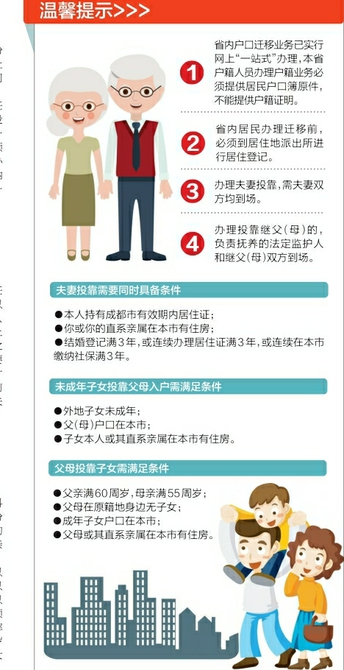
  From January 1 this year, Chengdu officially implemented the dual-track system of points settlement and academic qualifications. Then how can couples, parents and children rely on their relatives to settle down after one family member has settled down? On January 15th, Chengdu Public Security Micro-Household Administration released the relevant interpretation of the household registration policy in Chengdu, which mentioned that one of the husband and wife needs to register for marriage for three years or live in Chengdu for three consecutive years before they can settle down.

  Couples take refuge in households.

  Must be married for 3 years or have lived in Chengdu for 3 years.

  According to the interpretation released by the micro-household administration, couples who want to take refuge in households need to get married with people registered in Chengdu, and have lived in Chengdu for three consecutive years, so they can apply for household registration at their own or their immediate family members’ legally stable residence.

  In other words, couples need to meet these conditions at the same time: I hold a residence permit within the validity period of Chengdu; You or your immediate family members have housing in this city; Marriage registration for 3 years, or continuous residence permit for 3 years, or continuous payment of social security in this city for 3 years.

  The application materials required for couples to apply for household registration include: household registration book+ID card, marriage certificate, residence permit, housing certificate and social security list (provided that the marriage or residence permit has been processed for less than 3 years).

  Lu Jia, director of the accreditation center in Jinjiang District, Chengdu, said that in the past, there was no rigid requirement of "three years" for couples to join the household. "This one is new, but it is not necessary to register for marriage for three years. This is the same as applying for a residence permit for three years and paying social security for three years in this city. If one of the three items is met, you can apply for a couple to join the household."

  Minor children take refuge in their parents’ homes.

  Cancelled the relevant regulations that the house has been in the household for 5 years

  According to the interpretation of micro-household administration, minor children from other places, themselves or their immediate family members who have a legally stable residence, can apply for refuge with their parents registered in Chengdu. In other words, children need to meet these conditions: children from other places are underage; The parent’s household registration is in Chengdu; Children themselves or their immediate family members have housing in Chengdu.

  These application materials are needed when handling: children’s and parents’ household registration book+ID card, parents’ marriage certificate, housing certificate, children’s birth certificate or only child certificate or other proof of kinship.

  Lu Jia, director of the accreditation center in Jinjiang District, Chengdu, told the reporter that before relatives join the household, they will require "those who have entered Chengdu for more than 5 years due to house purchase, investment, tax payment, capital introduction and residence expiration", that is to say, before couples, children and parents join the household, they all need the house that they used to join the household for 5 years before they can apply for relatives to join the household. However, at present, this provision only applies to parents, and couples and children have cancelled this provision.

  Elderly parents take refuge in their children’s homes.

  The father must be 60 years old and the mother must be 55 years old.


  According to the interpretation of micro-household registration, male citizens who are not registered in Chengdu are over 60 years old, female citizens are over 55 years old and have no children around them. If I or my immediate family members have a legally stable residence in this city and need to rely on adult children registered in Chengdu, I or my immediate family members can apply for household registration at their legally stable residence. Only those who have lived in Chengdu for more than 5 years due to house purchase, investment, tax payment, investment attraction and residence expiration can apply for elderly parents outside Chengdu to take refuge.

  In other words, parents need to meet these conditions: the father is 60 years old and the mother is 55 years old; Parents have no children around their place of origin; Adult children’s household registration in this city; Parents or their immediate family members have housing in Chengdu.

  At the time of processing, the required application materials include: children’s and parents’ (parents’) household registration book+ID card, parents’ statement that they have no children at their place of origin, housing certificate, and proof of kinship between children and parents.

  There are some similarities and differences between elderly parents and their children. Lu Jia said, "In the past, parents could rely on their children to enter the home as long as they received a retirement certificate, but now they must be 60 or 55 years old." Lu Jia further explained that some parents may have gone through medical retirement at the age of 40 or 50, so they can rely on their children to go to the household, but now they can’t.

  ■ news extension

  Chengdu’s new household registration policy: "two tracks parallel"

  Conditional entry

  Twenty-three policies stipulated at the national level are implemented: transfer, placement, recruitment, military placement, family members’ joining the army, immediate family members’ refuge, foreign talents from abroad, high-level talents at home and abroad, postdoctoral fellows, and returning to their original places after serving their sentences.

  In line with the four policies of Chengdu’s talent priority development strategy: full-time graduates with bachelor’s degree or above, aged 45 and below; Persons who have obtained a bachelor’s degree or above outside the country (territory) and are certified by the Study Abroad Service Center of the Ministry of Education, and are under the age of 45; Skilled talents who have worked in the same employer for two years or more in this Municipality are recommended by the unit and recognized by the human resources and social security departments; People who have obtained the "Rongcheng Talent Green Card" can apply for entering the household.

  Integral entry

  Specific integral indicators include 12 indicators: paying social insurance, living legally and stably, educational background, guiding rational population distribution, guiding population gradient transfer, urgently needed job (occupation) indicators, personal contribution, encouraging innovation and entrepreneurship, age, personal bad credit record, personal criminal record and violation of family planning policy. When the standard score of points reaches 100 points, you are eligible to apply for points. (Reporter Feng Wei)


In 2021, the opening ceremony of the national common language training course for primary school Chinese backbone teachers and teaching researchers in ethnic minority areas was held in Beijing.

  Cctv news Recently, the opening ceremony of the 2021 national common language training course for primary school Chinese teachers and researchers in ethnic minority areas was held in Beijing, sponsored by the Language Application Management Department of the Ministry of Education, hosted by the National Education Development Center of the Ministry of Education, and co-organized by Higher Education Press and People’s Education Press.

  575 teachers from Guangxi, Sichuan, Guizhou, Yunnan, Xizang, Gansu, Qinghai, Ningxia and Xinjiang participated in the training. Henry Hui Wang, Deputy Director of the Department of Language Application Management of the Ministry of Education, guoyan, Director of the Center for Ethnic Education Development of the Ministry of Education, and Chen Xiaoguang, Editor-in-Chief of Higher Education Press, attended the opening ceremony of the training course and delivered speeches. Wu Xinxin, a researcher at the College of Liberal Arts of Beijing Normal University, attended the opening ceremony and gave the first lecture report to the students. The opening ceremony was presided over by Hu Wei, deputy director of the National Education Development Center of the Ministry of Education.

Meeting site

Meeting site

  In his speech, Chen Xiaoguang emphasized that this training is an in-depth practice of "teacher training in internet plus" to promote the sharing of high-quality educational resources, which is of great significance for popularizing the national common language and building a strong sense of the Chinese nation community. Henry Hui Wang summed up the significance of the training from the perspective of implementing the spirit of the important instructions of the Supreme Leader General Secretary and the relevant decision-making arrangements of the CPC Central Committee. He asked the students to improve their positions, fully understand that popularizing the national common language and characters is "the leader of the country", strengthen their responsibility and help strengthen the education of the national common language and characters, base themselves on their posts, and carry forward and inherit the excellent Chinese language and culture. In his speech, guoyan pointed out that this training is a vivid practice of studying and implementing the spirit of the "July 1st" important speech of the Supreme Leader General Secretary and doing practical things for the masses. It is also a practical action to serve the ethnic areas to build a high-quality education system, especially to build a high-quality professional teacher team, after the activities of improving the teaching and research ability last year, and put forward three hopes and requirements to all the students: carrying forward the great spirit of party building, practicing the initial intention of Lide Shuren, taking the sense of community of the Chinese nation as the main line, laying a solid foundation for students of all ethnic groups in the country, and upgrading their majors.

  This training is demand-oriented. In the early stage, through on-the-spot investigation and online questionnaire survey, the training needs of teachers in ethnic areas were accurately understood, and on this basis, the curriculum structure was adjusted and optimized, which improved the pertinence and effectiveness of the training. The training lasted for one month, and adopted a combination of synchronous live broadcast, asynchronous elective course and workshop discussion, closely following the weak links of Chinese teaching and the shortcomings of teachers’ ability, and developed a wealth of high-end lectures, teaching and research activities and interactive discussions, which helped to strengthen the construction of teachers’ morality and style in ethnic areas, improve teachers’ Chinese literacy and teaching and research ability, popularize the national common language and script, and build a strong sense of the Chinese nation community.

Heavy! From August 21st, the "Exorbitant Order" during the peak period in Shenzhen has been extended to all roads in the city!

  Starting from August 21st, Shenzhen extended the restricted area of non-deep-plate passenger cars (hereinafter referred to as "foreign cars") to the whole city.

Liu Xiaoding, Deputy Director of shenzhen public Traffic Police Bureau, introduced the expansion of the restricted scope.

Shenzhen traffic police Weibo screenshot

  Starting from August 21st, Shenzhen extended the restricted area of non-deep-plate passenger cars (hereinafter referred to as "foreign cars") to the whole city. On September 1st, the law was formally enforced. For vehicles that violate the traffic restrictions, 300 yuan will be punished according to the prohibition, and 3 points will be recorded.

What problems need to be understood to expand the restricted area of foreign cars during peak hours?

  1. The time limit is unchanged: it is still 7: 00-9: 00 and 17: 30-19: 30 in the morning and evening peaks of the working day;

  2. The type of foreign cars is unchanged: it is still a passenger car with a motor vehicle number plate issued by a non-local city;

  3. Implementation time: it will be implemented from August 21st, 2017 to January 31st, 2018, with the law enforcement buffer period from August 21st to August 31st, and the law enforcement will be officially implemented on September 1st.

  4. The restricted area for foreign vehicles has been extended from the current "inside the original special zone+part outside the original special zone" to the whole city of Shenzhen (except for expressways and some roads at import and export ports and airports).

Is there an exception to the rush hour restriction for foreign cars?

  Yes! For the first, military vehicles, police cars, fire engines, ambulances and engineering rescue vehicles that perform tasks; Passenger vehicles with road transport documents (excluding rental cars); Hong Kong license plate vehicles (including Hong Kong mainland license and Mainland Hong Kong license) and embassy license plate vehicles are not subject to restrictions on foreign vehicles. Second, if the passenger cars with motor vehicle license plates issued by non-local cities need to pass through the closed time and roads due to national and provincial large-scale conferences, exhibitions and other activities, they should go to the municipal traffic police department in advance to apply for temporary motor vehicle passes, and only after approval can they pass according to the regulations.

Except for the morning and evening rush hours, can non-deep number plates pass normally in Shenzhen?

  Can! Shenzhen traffic police only limit the peak traffic demand, not the general traffic demand. Shenzhen’s "out-of-hours" are the morning peak (7: 00-9: 00) and the evening peak (17: 30-19: 30) on weekdays, and there are no restrictions on other time periods and legal holidays. Overall, the restricted time only accounts for 13.8% of the total time. Note: Off-site passenger vehicles (excluding rental cars) with road transport certificates are not subject to "out-of-limit" measures.

What should I do if the new regulations are introduced and the regulations are violated for a while?

  Forgive you, of course! If a foreign car is recorded on several restricted roads during a working day, it is only recognized as a driving record; And those who violate the restrictions for the first time and the second time will not be punished, and will be punished according to law from the third time, which is referred to as "starting punishment once a day and three times". If drivers of non-deep-license motor vehicles need to use their cars in rush hours under special circumstances, they can log in to the entrance of "Self-declaration of non-deep-license passenger cars entering Shenzhen" on the website of Shenzhen Traffic Police Bureau, and declare in advance can "exempt" from driving once a month in restricted time and road sections.

  As a "foreign car", why do you want to restrict my travel?

  First, expanding the restricted range of non-deep license plate vehicles is a work requirement for strengthening the prevention and control of air pollution;

  Second, the use of foreign vehicles has maintained a high growth trend, and effective measures need to be taken to control the travel demand of motor vehicles and alleviate road traffic congestion;

  Third, the new round of urban construction climax is mainly concentrated in areas outside the original special zone, and it is urgent to proactively regulate the city’s traffic demand from the demand side;

  Fourth, the comprehensive promotion of new energy vehicles needs supporting policies to guide them. Today’s inconvenience is to make the city where we live more smooth and orderly and the environment more beautiful! (Reporter Tu Sheng)

Countdown of state-owned assets transfer social security! Trillion state-owned disability pension

  The reform of transferring state-owned assets to social security entered the countdown stage in December. According to the established timetable, China will basically complete the transfer of central and local state-owned enterprises by the end of 2020.

  Central enterprises have taken the lead in transferring social security. As early as 2019, they completed the transfer of 1.3 trillion yuan from 81 enterprises, and the transfer of local state-owned enterprises will reach its climax in 2020. From the beginning of the year to the end of the year, various provinces have issued transfer plans and demanded that the transfer plan be basically completed by the end of this year.

  The latest policy is Beijing. On December 8, the Beijing Municipal Government announced the Implementation Plan for Beijing to Transfer Part of State-owned Capital to Enrich the Social Security Fund (hereinafter referred to as the Plan). The "Proposal" proposes that the transfer ratio should be unified to 10% of the state-owned shares of enterprises included in the transfer scope, so as to ensure that the transfer work will be basically completed by the end of 2020.

  2020 is an important time node for the reform of China’s endowment insurance system. This year, we should not only complete the transfer of state-owned assets, but also realize the provincial-level overall planning of endowment insurance funds. These two reforms will lay the foundation for the next national overall planning.

  Dong Dengxin, director of the Institute of Financial Securities of Wuhan University of Science and Technology, told CBN that according to the plans of provinces, the shares transferred by local state-owned assets are stored in financial accounts and entrusted to state-owned holding investment companies for value-added and value-added operation, but this kind of local management is in a transitional state of escrow. Once the national pension insurance is coordinated, the social security fund managed by the provincial government and the state-owned shares transferred by state-owned assets will be managed by the National Social Security Fund Council.

  At the same time, CBN learned that the Ministry of Finance is taking the lead in drafting operational management measures for the transfer of state-owned capital. The documents issued in some places this year clearly stated that after the introduction of the management measures for the transfer of state-owned capital by the central government, the local financial departments will separately formulate corresponding specific implementation measures.

  More than one trillion state-owned running to help the pension.

  The above-mentioned "Proposal" proposes that Beijing will enrich the social security fund by transferring some state-owned capital, and establish an operating mechanism that combines the transfer of state-owned capital with the gradual filling of the gap in the basic endowment insurance fund for enterprise employees, so that the people can share the development achievements of state-owned enterprises, realize intergenerational equity and enhance the sustainability of the system.

  The impact of aging on the financial situation of China’s old-age insurance fund is increasingly obvious. The arrival of the first generation of "baby boom" retirement peak requires China to strengthen the sustainability of the old-age insurance fund.

  In November 2017, China launched a pilot project of state-owned assets transfer, which was fully launched in September 2019. At the central level, qualified enterprises were required to be basically completed by the end of 2019, and difficult enterprises could be completed by the end of 2020; At the local level, the transfer work will be basically completed by the end of 2020.

  By the end of 2019, the central level has completed the transfer of 1.3 trillion yuan. The industry predicts that the total scale after the transfer will be 3 trillion to 5 trillion yuan, which means that at least 2 trillion yuan will be completed before the end of 2020.

  These 2 trillion funds will provide an important guarantee for China’s old-age insurance system, especially in the case that the old-age insurance fund has been greatly reduced due to the epidemic, and the acceleration of the transfer of state-owned assets to social security has also provided a "reassuring" for the majority of insured people.

  The epidemic did not hinder the transfer of state-owned assets to social security. When consulting local documents, CBN found that since the end of March, when the epidemic eased slightly, many provinces began to introduce plans for allocating social security by state-owned assets. For example, Henan, Hunan and other places introduced plans in April, Chongqing in July, Shanghai in September, and after entering November, Shandong, Gansu, Beijing and other places also promptly introduced relevant plans.

  State-owned assets are earmarked to make up for the pension gap.

  From the content point of view, the schemes in different places are basically the same, and the transfer scope, transfer target and income mode are consistent with the principle of "Notice of the State Council on Printing and Distributing the Implementation Plan for Transferring Part of State-owned Capital to Enrich Social Security Fund" (Guo Fa [2017] No.49), for example, the transfer ratio is 10% of the state-owned equity of the enterprise, and the undertaker does not interfere with the daily production, operation and management of the enterprise.

  Beijing’s "Proposal" reiterates that the equity dividends and operating income after the transfer of state-owned assets shall be collected in a timely manner by the Municipal Finance Bureau, taking into account the expenditure needs of the basic old-age insurance fund and the income of state-owned capital, and shall be used exclusively to make up for the gap in the basic old-age insurance fund for enterprise employees, and shall not be included in the budget management of state-owned capital operation. Before the introduction of the management measures for the transfer of state-owned capital, the scope of investment was limited to bank deposits, the purchase of government bonds in the primary market and the capital increase of the transfer target. The entrusted management company is responsible for the specific operation of equity dividends.

  Earlier, when the transfer of state-owned assets was fully pushed forward, the relevant person in charge of the Ministry of Finance said in a reporter’s question that after the transfer of state-owned capital to enrich the social security fund, the way for the undertaker to obtain income was "dividend-based, supplemented by operation". That is to say, the income of state-owned capital mainly comes from equity dividends. In the future, the financial departments at the same level of each undertaking entity will consider the expenditure needs of the basic old-age insurance fund and the income of state-owned capital as a whole, and implement the collection in a timely manner to make up for the gap of the basic old-age insurance fund for enterprise employees.

  In addition, another principle of state-owned assets transfer is to be a "sleeping shareholder", that is, the undertaker, as a financial investor, enjoys the right to income, the right to dispose of and the right to know the state-owned shares, does not interfere with the daily production and operation management of enterprises, and generally does not send directors to enterprises.

  When combing the local documents, CBN also found that the local governments are slightly different in undertaking subjects, and most provinces are authorized by the finance department. For example, the state-owned shares of enterprises transferred by Jilin Province are held by the provincial finance department on behalf of the provincial government, and Jilin Equity Fund Investment Co., Ltd. is the undertaking subject, but there are also some provinces that are different. For example, Heilongjiang Province authorized the provincial SASAC as the undertaking subject of the state-owned shares of enterprises transferred by the province.

  Judging from the progress of local transfer, Hebei has announced that 21 provincial state-owned enterprises have transferred some state-owned assets to enrich the social security fund and transferred state-owned capital of 19.326 billion yuan; Guangxi announced the completion of the transfer of 18 state-owned enterprises at the district level.

  Measures for the operation and management of state-owned capital will be introduced

  Transferring some state-owned capital to enrich the social security fund is an important measure to reform and improve China’s basic old-age insurance system, and it is also a full embodiment of the sharing of the development achievements of state-owned enterprises by the whole people.

  A local state-owned enterprise told the First Financial Reporter that the transfer process is much more difficult than expected, and both central enterprises and local state-owned enterprises have different degrees of difficulties. Local state-owned enterprises have greater difficulties, so it takes longer to transfer the reserved funds.

  He said that the number of local state-owned enterprises is large and the situation is complicated. In some places, the property rights of state-owned enterprises have not been completely straightened out, and it is impossible to determine the number of transfers. In some places, state-owned enterprises are not well managed or even face bankruptcy, which makes it impossible to transfer them. Some enterprises have changed the scope and scale of transfer due to the implementation of reforms such as reorganization and restructuring. Others involve listed companies, especially overseas listed companies, and the transfer process is more complicated.

  The above-mentioned state-owned enterprises also said that at present, the undertakers in different provinces are not the same, some are social security fund councils, while others are state-owned capital operation companies, and the process of transfer is not smooth due to the unsatisfactory system. Moreover, the management and operation ability of the undertaker is also uneven, which affects the income of state-owned capital.

  Peng Huagang, spokesman of the State-owned Assets Supervision and Administration Commission of the State Council, said that the main task in the next step is to deepen the reform of state-owned enterprises, urge enterprises to better improve efficiency and create benefits, and make these shares transferred to the social security fund obtain tangible benefits.

  Li Jin, chief researcher of China Enterprise Research Institute, told the First Financial Reporter that the biggest challenge will be how to preserve and increase the value, how to pay dividends and how to collect the proceeds. Generally speaking, the allocation of state-owned assets to social security funds is positive from a big perspective, and the problems brought about by it need to be designed at the institutional level.

  How to make "huge deposits" play its due role, industry analysis, on the one hand, state-owned enterprises should better improve efficiency, create benefits and create value by accelerating reforms, so that these shares transferred to social security funds can obtain tangible benefits. On the other hand, the equity dividends of the transferred enterprises will be the main source of income for social security funds from the transfer of state-owned assets. The dividend level of listed companies in China is not high, and it is necessary to further increase the dividend ratio of state-owned enterprises in order to play the role of ensuring the transfer of funds.

  The first financial reporter learned that in order to standardize the operation and management of transferring some state-owned capital, enrich the social security fund and strengthen the supervision of the operation and management of transferring state-owned capital, the Ministry of Finance is taking the lead in drafting the operation and management measures for transferring state-owned capital.

  Before the introduction of the management measures for the transfer of state-owned capital, the cash income generated by the transfer of state-owned capital can be invested by the undertaker, and the scope of investment is limited to bank deposits, the purchase of government bonds in the primary market and the capital increase of the transferred object. At the same time, all levels of finance, human resources and social security, state-owned assets supervision and other relevant departments will strengthen cooperation, earnestly perform their duties, strengthen supervision and management of the undertakers, and ensure that the transferred state-owned capital is earmarked to make up for the gap in the basic endowment insurance fund for enterprise employees.

  When managing this part of assets, asset security should be the primary goal. Li Jin said that this part of the state-owned assets transferred to social security should be operated safely to ensure the preservation and appreciation of state-owned assets. These assets need to be handed over to professionals for operation, and they can participate in projects with good benefits and stable income in the supply-side structural reform.

Another Ponzi scheme is exposed! 2 billion yuan was raised, over 1.8 billion yuan was unpaid, and 1,400 investors were cheated.

Every edited | Wang Xiaobo Xu Hao    

In the capital market, there has never been a shortage of cases of "thunder", but it is rare to raise funds illegally in the name of investment under the guise of private placement, which is what Zhongjin Guorui did.This "Ponzi scheme" raised more than 2.155 billion yuan. In the end, more than 1.8 billion yuan was unpaid, and 1,400 investors were miserable.

b6eff5c6.jpeg

Image source: Photographic network (graphic has nothing to do)

Established in 2011, Zhongjin Guorui (full name: Shenzhen Zhongjin Guorui Fund Management Co., Ltd.) has a registered capital of 100 million yuan, and the actual controller is Qin Peng. After completing the filing and registration in June 2014, it became a private equity investment manager. On May 22, 2019, Zhongjin Guorui, who has always paid in time, suddenly issued a liquidation notice, announcing that it would no longer pay the principal and interest, leaving more than 1 billion capital holes, which suddenly triggered a shock in the industry.

On July 9, 2020, the Shenzhen Municipal People’s Procuratorate issued a Notice on the Rights and Obligations of Victims of Qin Peng’s Suspected Crime of Fund-raising Fraud and Nine People, including Zheng Mingming, Yin Jie and Zhou Kairan, were suspected of illegally absorbing public deposits. The case of Qin Peng, the suspect, Zheng Mingming, Yin Jie and Zhou Kairan, the suspect, was recently transferred to the Shenzhen Municipal People’s Procuratorate by the Futian Branch of shenzhen public for review and prosecution.

7e51eee0.png

Image source: Shenzhen People’s Procuratorate

Over 1.8 billion outstanding, involving 1,400 investors.

According to the Notice issued by the Shenzhen Municipal People’s Procuratorate, the investigation organ found that Zhongjin Guorui did not use all the funds for futures and securities trading as agreed after publicly raising funds from unspecified people by means of public publicity, promising income returns and guaranteeing capital and interest, but directly used them as the company’s own funds to allocate and use according to actual needs. Most of them were used to pay the principal and income of investors due, and the rest were used for futures and securities trading. The operating expenses of the company, employees’ salaries, commissions, personal consumption in Qin Peng, foreign investment, repayment of the company’s historical debts, and some funds were transferred overseas to start companies and do transactions, resulting in a large amount of investment funds that could not be recovered and the overdue amount was huge.

At present,The amount raised by the three funds involved in the case issued by the company is 2.155 billion yuan, the amount paid to investors is 313 million yuan, and the amount unpaid to investors is 1.841 billion yuan, involving 1400 investors.

The Shenzhen Municipal People’s Procuratorate also stated that due to the large number of victims in this case, according to the relevant regulations, some victims could not be delivered after contact with our hospital, and now the victims in this case are informed of their litigation rights and obligations by means of announcement.

On February 7, 2020, the Shenzhen People’s Procuratorate approved the arrest of the suspect Qin Peng on suspicion of fund-raising fraud, and approved the arrest of nine people including Zheng Moming on suspicion of illegally absorbing public deposits.

954f52bd.png

Before the incident, I was still raising funds to set up new products.

Their own employees also pit together.

According to the information of private placement network, Qin Peng once worked for China Merchants Bank and Yintai Securities. The fund products managed by Zhongjin Guorui Fund cover stock type, hybrid type, quantitative type, FOF type and asset securitization, but many of them have been liquidated in advance, including Zhongjin Guorui Mixed Strategy No.3 Private Equity Investment Fund and Zhongjin Guorui Stock Strategy Quantitative Private Equity Fund No.1..

The private placement was also registered with the association on April 28, 2019 for the Zhongjin Guorui Strategy No.1 Private Equity Investment Fund.

On May 14th, 2019, Qin Peng announced at an internal meeting that the product would be liquidated, no more funds would be raised and the principal and income would be paid normally.This caused an uproar within the company, because about 90% of employees have invested in their own products.

After the liquidation notice came out on May 22, 2019, a large number of investors rushed to the office of Zhongjin Guorui, located on the 36th floor of China Merchants Bank Building, to learn about the situation, and learned that Zhou Caihong, the financial controller of the company, and Xiang Jieming, the head of the risk control department, had left in April, and the company was in a state of suspension. A series of materials provided by investors show that Zhongjin Guorui claims to invest 20% as inferior funds to protect the safety of investors’ principal, giving investors fixed income ranging from 10% to 14% every year, and the excess part belongs to the fund company.

Qin Peng may be sentenced to more than 15 years in prison

According to the Notice issued by Shenzhen Procuratorate, in addition to Qin Peng, there are also senior employees such as Zheng Mingming and Yin Jie, and a total of 10 people were involved in the case, including personnel administration manager, financial controller and fund sales.

According to the Securities Times, lawyer Wang Zhihui, a partner of Zhejiang Highgarden Law Firm, said that the actual controller Qin Peng was suspected of fund-raising fraud, and the amount was huge. If convicted, he would be sentenced to more than 15 years’ imprisonment or life imprisonment.

In addition, nine people, including executives and employees of Zhongjin Guorui, were suspected of illegally absorbing public deposits. Lawyer Wang Zhihui judged that if convicted, they would be sentenced to 3 to 10 years in prison.

Details of the persons involved:

The suspect, Qin Peng,He is the legal representative and actual controller of affiliated companies such as Shenzhen Zhongjin Guorui Fund Management Co., Ltd., Shenzhen Zhongjin Guorui Capital Management Co., Ltd. and Shenzhen Zhongjin Guorui Holdings Co., Ltd., and is responsible for the overall affairs of Shenzhen Zhongjin Guorui Fund Management Co., Ltd. and its affiliated companies, futures securities trading, the right to use capital allocation and foreign investment.

The suspect, Zheng Mingming,He is the company’s vice president and manager of the second marketing department, in charge of the second marketing department, the trading department, the customer service department and the sales of fund products.

The suspect Zhou Kairan,He is the chief financial officer of the company, responsible for managing the accounting and cashier of the finance department, daily financial review, futures and securities account management and financial approval, and assisting Qin Peng in allocating funds.

The suspect, Yin Jie,He is the manager of the first marketing department of the company, responsible for managing the performance appraisal of a financial manager and selling fund products.

The suspect, Wenna,He is the personnel administration manager of the company, responsible for personnel administration. In March 2018, he was sent to Hong Kong by Qin Peng to be responsible for the affairs of the affiliated company Hong Kong Fuyin Group. In August 2018, he worked as the head of the comprehensive department of the affiliated company Huashi Health Management Group, responsible for personnel administration.

The suspects Wang Tianyu, Wang Wei and Li Hongliang,He is the team leader of the second marketing department of the company, responsible for team management and sales of fund products.

The suspect is Wei Wei,He is the head of the marketing department of the company, responsible for team management and sales of fund products.

The suspect, Zhang Liqun,He is the financial manager of Wang Tianyu team in the second marketing department of the company, and is responsible for selling fund products.

Private placement qualification was cancelled, and the main person in charge was "blacked out"

In May this year, China Fund Industry Association announced the disciplinary decision against Zhongjin Guorui, which stated in detail six illegal facts of Zhongjin Guorui, and made relevant sanctions against the company and its principal responsible persons. Disciplinary action was taken to "cancel membership and cancel administrator registration".

74824f8b.png

The punishment decision shows that Zhongjin Guorui’s illegal facts mainly include: 1. After the private equity fund was raised, it was not filed with the China Foundation in accordance with the regulations; 2. The number of people raised for a single product exceeds the specified number stipulated by laws and regulations; 3. Raising funds from unqualified investors in the process of raising private equity funds; 4. Introduce private equity products to unspecified investors; 5. Promise investors that the principal will not be lost or the minimum income; 6. Failure to report major issues to the Association in time.

The China Foundation also announced the decision on the punishment of the main person in charge of Zhongjin Guorui, and Qin Peng was punished by "blacklisting for five years". Xiang Jieming, the person in charge of compliance risk control, is also proposed to take disciplinary action of "joining the blacklist for a period of three years".

79445526.png

National business daily synthesis

Securities Times, China Fund News, China, a brokerage firm, and every APP.

Cover image source: national business daily Liu Guomei photo (data map)

According to the new regulations, "no reason to return goods" will no longer be applicable to online shopping of these seven categories of goods.

  CCTV News:Attention online shoppers! On the 27th, the State Administration for Industry and Commerce announced the "Implementation Measures for the Seven-day Unreasonable Return of Goods Purchased Online (Draft for Comment)", and publicly solicited opinions from the public. The exposure draft intends to limit the inapplicability of online shopping for seven days without reason to seven categories, such as goods ordered by consumers and fresh and perishable goods. Consumers’ opening the package of goods based on inspection needs, or reasonable debugging to confirm the quality and function of goods will not affect the integrity of goods, and shall not be used as reasons for refusing to return goods. Many details are related to the interests of consumers and businesses. If you have any comments, you can put them forward before October 11th.

  Can unpacked goods be returned without reason?

  Unpacking and debugging will not affect the integrity of the goods.

  The Consumer Protection Law stipulates that the goods returned by consumers should be in good condition. However, the connotation and standard of commodity integrity are not clear in this law. Consumers and businesses have different understandings of the integrity of goods, which has become one of the controversial focuses of unreasonable return.

   The exposure draft defines the connotation and standard of commodity integrity: a commodity is considered to be intact if it can maintain its original quality and function, and the commodity itself, accessories and trademark marks are complete. The exposure draft further clarifies that consumers will not affect the integrity of the goods if they open the packaging of the goods based on the inspection needs, or make reasonable debugging to confirm the quality and function of the goods.

   However, some operators not only require the goods themselves to be intact, but also the packaging of the goods must be complete, and even require that the goods should not be opened and tried. This limits the rights of consumers to some extent.

  In addition, the exposure draft also stipulates that if the consumer refuses to return the goods for more than fifteen days on the grounds that the goods have been unpacked and inspected, it will be punished in accordance with the relevant provisions of Article 56 of the Consumer Protection Law.

  Will it be easier to buy second-hand goods?

  Goods that cannot be restored to their original state should be clearly marked.

  The exposure draft creates a system of inspection and re-circulation of goods returned without reason, and clearly stipulates that online commodity sellers should establish perfect inspection and handling procedures for goods returned without reason.

  The exposure draft stipulates that goods that can be completely returned to the initial sales state for no reason can be resold as brand-new goods; If there is no reason to return the goods that cannot be completely restored to the original state and then sell them again, the actual situation of the goods should be clearly marked in a significant way.

  If it is not clearly marked for sale, it may be fined 10,000-30,000 yuan in the future. According to the exposure draft, if the goods that cannot be completely restored to the initial state are returned without reason, and the actual situation of the goods is not clearly marked in a significant way, those who violate other laws and administrative regulations will be punished in accordance with the provisions of relevant laws and administrative regulations; If there are no provisions in laws and administrative regulations, it shall be given a warning, ordered to make corrections, and imposed a fine of not less than 10,000 yuan but not more than 30,000 yuan.

  What about the gifts? Who will bear the return freight?

  Gifts should be returned to consumers to bear the freight.

  Do I need to return the gifts when I return them? The exposure draft proposes that consumers should return the goods themselves, accessories and gifts together when returning goods. Gifts include gifts in kind, points, vouchers, coupons and other forms. If the gifts can’t be returned together, the operator can ask the consumer to pay the gift price at the market price.

  Who will bear the freight? The exposure draft makes it clear that the freight generated by the return of goods shall be borne by consumers according to law. Unless otherwise agreed between the operator and the consumer, such agreement shall prevail. If a consumer participates in a free shipping activity that meets certain conditions, but can’t meet the requirements of the free shipping activity after returning the goods, the online commodity seller can deduct the shipping (delivery) freight when refunding.

  When can I receive the refund at the latest? The exposure draft makes it clear that online commodity sellers should return the paid commodity price to consumers within seven days from the date of receiving the returned commodity.

  What goods are not suitable for no reason to return?

  Clarify the scope of seven categories to avoid expanding the explanation of merchants

  The Consumer Protection Law stipulates that four types of goods are not applicable to unreasonable return, including:

  Goods ordered by consumers;

  Fresh and perishable goods;

  Digital commodities such as audio-visual products and computer software downloaded online or unpacked by consumers;

  Delivered newspapers and periodicals.

  At the same time, it is stipulated that other goods that are not suitable for return according to the nature of the goods and confirmed by consumers at the time of purchase are not suitable for unreasonable return.

  In practice, operators and consumers have different understandings about which "other" goods can be returned without reason. Some operators even expand the explanation of the types of goods that are not returned without reason, and to some extent, the unreasonable return system is empty, which often leads to consumer disputes.

  To this end, the exposure draft reiterated that four types of goods are not applicable to unreasonable return, and also listed three types of goods that are confirmed by consumers at the time of purchase to be exempt from the seven-day unreasonable return rule:

  (1) Commodities that are easy to change the nature of commodities and affect personal safety or life and health after unpacking;

  (two) once activated or tried, the value of the goods is greatly derogated;

  (three) the goods that are close to the shelf life and defective goods that have been clearly stated at the time of sale.

  Liu Junhai, director of the Institute of Commercial Law of Renmin University of China, said that the exposure draft further refines the scope of goods that are not applicable for return, which helps to avoid expanding explanations by merchants and reduce online shopping return disputes.

  How should I give feedback if I have opinions?

  Four ways: website, letter and email.

  ① Log on to the Legal Information Network of China Municipal Government, and put forward opinions on the draft for comments through the "Opinions Collection System for Draft Regulations" on the left side of the homepage of the website.

  Log on to the website of the State Administration for Industry and Commerce, and put forward opinions through the "Collection of Opinions on Draft Regulations" column on the right side of the home page.

  ③ Send the comments by letter to the Consumer Protection Bureau of the State Administration for Industry and Commerce, No.8 Sanlihe East Road, Xicheng District, Beijing (postcode: 100037).

  (4) send comments to the mailbox by email.

  ▌ This article Source: China News Network

A large case of misappropriation of funds of 100 million yuan "difficult to live" The prosecutors in Hubei and Shandong were accused of serious overdue.

A major case of misappropriation of funds involving more than 100 million yuan in Hubei, after the Wuhan prosecutor prosecuted it to the Wuhan court, the court returned the case to the procuratorate for lack of jurisdiction. This case is due to jurisdiction dispute."Stuck" for nearly a year. After that, the Hubei Provincial Procuratorate asked the Supreme People’s Procuratorate for instructions on the designated jurisdiction, and after obtaining the approval, the case was transferred to the Shandong prosecutor. Qingzhou City Procuratorate of Shandong Province is now responsible for the review and prosecution of this case. Xu Guijuan, the attorney of the victim Wuhan Kaisen Chemical Co., Ltd. (hereinafter referred to as Wuhan Kaisen Company), told the reporter that the case has been "stranded" again, which has seriously exceeded the statutory time limit for review and prosecution, and Qingzhou City Procuratorate has not yet made a decision on prosecution.

Screenshot of relevant provisions in the Civil Procedure Law.

Screenshot of relevant provisions in the Civil Procedure Law.

The Supreme People's Procuratorate and the Ministry of Public Security jointly issued "Several Provisions on Handling Economic Crime Cases by Public Security Organs". Screenshot of the official website page.

The Supreme People’s Procuratorate and the Ministry of Public Security jointly issued "Several Provisions on Handling Economic Crime Cases by Public Security Organs". Screenshot of the official website page.

The Supreme People's Procuratorate issued a notice to protect the legitimate rights and interests of entrepreneurs according to law. Screenshot of the official website page.

The Supreme People’s Procuratorate issued a notice to protect the legitimate rights and interests of entrepreneurs according to law. Screenshot of the official website page.