According to the new regulations, "no reason to return goods" will no longer be applicable to online shopping of these seven categories of goods.
CCTV News:Attention online shoppers! On the 27th, the State Administration for Industry and Commerce announced the "Implementation Measures for the Seven-day Unreasonable Return of Goods Purchased Online (Draft for Comment)", and publicly solicited opinions from the public. The exposure draft intends to limit the inapplicability of online shopping for seven days without reason to seven categories, such as goods ordered by consumers and fresh and perishable goods. Consumers’ opening the package of goods based on inspection needs, or reasonable debugging to confirm the quality and function of goods will not affect the integrity of goods, and shall not be used as reasons for refusing to return goods. Many details are related to the interests of consumers and businesses. If you have any comments, you can put them forward before October 11th.

Can unpacked goods be returned without reason?
Unpacking and debugging will not affect the integrity of the goods.
The Consumer Protection Law stipulates that the goods returned by consumers should be in good condition. However, the connotation and standard of commodity integrity are not clear in this law. Consumers and businesses have different understandings of the integrity of goods, which has become one of the controversial focuses of unreasonable return.
The exposure draft defines the connotation and standard of commodity integrity: a commodity is considered to be intact if it can maintain its original quality and function, and the commodity itself, accessories and trademark marks are complete. The exposure draft further clarifies that consumers will not affect the integrity of the goods if they open the packaging of the goods based on the inspection needs, or make reasonable debugging to confirm the quality and function of the goods.
However, some operators not only require the goods themselves to be intact, but also the packaging of the goods must be complete, and even require that the goods should not be opened and tried. This limits the rights of consumers to some extent.
In addition, the exposure draft also stipulates that if the consumer refuses to return the goods for more than fifteen days on the grounds that the goods have been unpacked and inspected, it will be punished in accordance with the relevant provisions of Article 56 of the Consumer Protection Law.

Will it be easier to buy second-hand goods?
Goods that cannot be restored to their original state should be clearly marked.
The exposure draft creates a system of inspection and re-circulation of goods returned without reason, and clearly stipulates that online commodity sellers should establish perfect inspection and handling procedures for goods returned without reason.
The exposure draft stipulates that goods that can be completely returned to the initial sales state for no reason can be resold as brand-new goods; If there is no reason to return the goods that cannot be completely restored to the original state and then sell them again, the actual situation of the goods should be clearly marked in a significant way.
If it is not clearly marked for sale, it may be fined 10,000-30,000 yuan in the future. According to the exposure draft, if the goods that cannot be completely restored to the initial state are returned without reason, and the actual situation of the goods is not clearly marked in a significant way, those who violate other laws and administrative regulations will be punished in accordance with the provisions of relevant laws and administrative regulations; If there are no provisions in laws and administrative regulations, it shall be given a warning, ordered to make corrections, and imposed a fine of not less than 10,000 yuan but not more than 30,000 yuan.
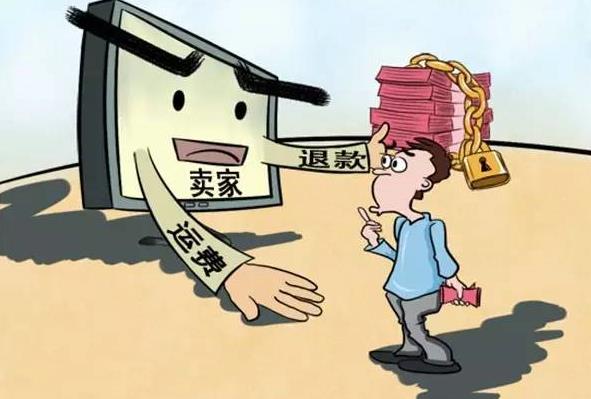
What about the gifts? Who will bear the return freight?
Gifts should be returned to consumers to bear the freight.
Do I need to return the gifts when I return them? The exposure draft proposes that consumers should return the goods themselves, accessories and gifts together when returning goods. Gifts include gifts in kind, points, vouchers, coupons and other forms. If the gifts can’t be returned together, the operator can ask the consumer to pay the gift price at the market price.
Who will bear the freight? The exposure draft makes it clear that the freight generated by the return of goods shall be borne by consumers according to law. Unless otherwise agreed between the operator and the consumer, such agreement shall prevail. If a consumer participates in a free shipping activity that meets certain conditions, but can’t meet the requirements of the free shipping activity after returning the goods, the online commodity seller can deduct the shipping (delivery) freight when refunding.
When can I receive the refund at the latest? The exposure draft makes it clear that online commodity sellers should return the paid commodity price to consumers within seven days from the date of receiving the returned commodity.
What goods are not suitable for no reason to return?
Clarify the scope of seven categories to avoid expanding the explanation of merchants
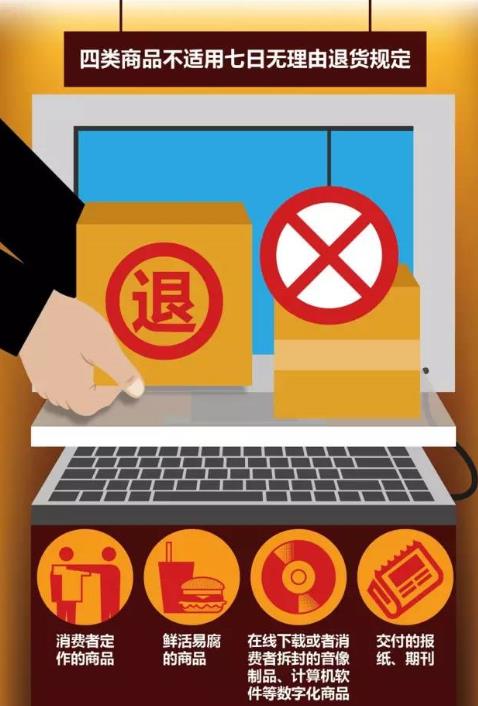
The Consumer Protection Law stipulates that four types of goods are not applicable to unreasonable return, including:
Goods ordered by consumers;
Fresh and perishable goods;
Digital commodities such as audio-visual products and computer software downloaded online or unpacked by consumers;
Delivered newspapers and periodicals.
At the same time, it is stipulated that other goods that are not suitable for return according to the nature of the goods and confirmed by consumers at the time of purchase are not suitable for unreasonable return.
In practice, operators and consumers have different understandings about which "other" goods can be returned without reason. Some operators even expand the explanation of the types of goods that are not returned without reason, and to some extent, the unreasonable return system is empty, which often leads to consumer disputes.

To this end, the exposure draft reiterated that four types of goods are not applicable to unreasonable return, and also listed three types of goods that are confirmed by consumers at the time of purchase to be exempt from the seven-day unreasonable return rule:
(1) Commodities that are easy to change the nature of commodities and affect personal safety or life and health after unpacking;
(two) once activated or tried, the value of the goods is greatly derogated;
(three) the goods that are close to the shelf life and defective goods that have been clearly stated at the time of sale.
Liu Junhai, director of the Institute of Commercial Law of Renmin University of China, said that the exposure draft further refines the scope of goods that are not applicable for return, which helps to avoid expanding explanations by merchants and reduce online shopping return disputes.
How should I give feedback if I have opinions?
Four ways: website, letter and email.
① Log on to the Legal Information Network of China Municipal Government, and put forward opinions on the draft for comments through the "Opinions Collection System for Draft Regulations" on the left side of the homepage of the website.
Log on to the website of the State Administration for Industry and Commerce, and put forward opinions through the "Collection of Opinions on Draft Regulations" column on the right side of the home page.
③ Send the comments by letter to the Consumer Protection Bureau of the State Administration for Industry and Commerce, No.8 Sanlihe East Road, Xicheng District, Beijing (postcode: 100037).
(4) send comments to the mailbox by email.
▌ This article Source: China News Network