Japan’s epidemic situation is deteriorating. Should the Tokyo Olympics be "backed up"?
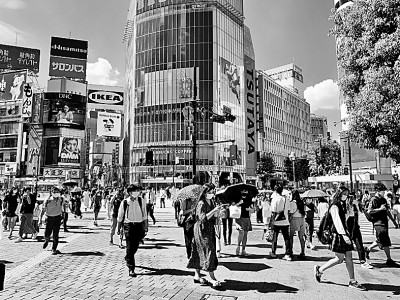
The streets of Tokyo in a state of emergency are still crowded. Photo by Tian Yuxi/Bright Picture
[reporter connected]
When the Tokyo Olympic Games is in full swing, the situation of COVID-19 epidemic in Japan is deteriorating. On August 5th, 15,263 cases of COVID-19 were confirmed in Japan, exceeding 15,000 cases for the first time, reaching a new high in a single day. Among them, there were 5,042 new cases in Tokyo, the host city of the Olympic Games, which was the first time that there were more than 5,000 new confirmed cases in a single day in this region, creating a new high for two consecutive days. As of press time on the 6th, there were 4,515 new confirmed cases in Tokyo that day. The number of new cases in other areas involved in the Olympic Games, such as Chiba and Kanagawa, has also hit record highs in recent days.
At an expert meeting held in Tokyo on the 5th, experts attending the meeting believed that the COVID-19 epidemic in Tokyo was rapidly expanding, with an average of more than 3,000 new confirmed cases per day in the past seven days, an increase of seven times in one month. Therefore, Japanese experts predict that according to the current growth rate, the number of newly confirmed cases in Tokyo will reach 6,129 on August 11th and 10,909 on August 18th. In fact, as early as before the Tokyo Olympic Games, Japanese nationals tried their best to boycott the Tokyo Olympic Games for fear that the epidemic would intensify. They believe that the entry of a large number of foreigners will inevitably aggravate the domestic epidemic situation, and for the safety of Japanese people, the Tokyo Olympic Games should be cancelled.
However, is the worsening epidemic situation in Japan really due to hosting the Olympic Games?
On July 8 this year, Japanese Prime Minister Suga Yoshihide announced that Tokyo was once again in a state of emergency, and the implementation period was from July 12 to August 22. This is the fourth time that Tokyo, the host city of the Olympic Games, entered a state of emergency due to the COVID-19 epidemic. This also means that the Tokyo Olympic Games was held in a state of emergency in Tokyo, which directly led to almost all the Olympic Games being held in the absence of spectators. Undeniably, during the holding of the Tokyo Olympic Games, some Olympic-related personnel left the Olympic site and went to public places without authorization, and were disqualified from participating in the Tokyo Olympic Games. However, such cases are rare after all.
The state of emergency is "not as good as once"
Unlike the anti-epidemic measures of "closing cities" in most countries, Japanese local governments only publish the list of those who violate the regulations to uncooperative people or enterprises. Most people call this "soft anti-epidemic". For example, the government requires restaurants that provide alcohol to close down, and restaurants that do not provide alcohol to shorten their business hours; Large supermarkets shut down on weekends and shorten their business hours at ordinary times; Shorten the business hours of museums and cinemas; People try to avoid going out, and enterprises try to work at home. Therefore, the Japanese media believe that the effect of the state of emergency is now "not as good as once."
In view of this, the Japanese government also wants to adopt the method of economic compensation to encourage businesses that respond to the government’s call to shorten their business hours, but it is reported that many businesses have not received the subsidies promised by the Japanese government. As a last resort, they had to save themselves to avoid missing the night economy in summer. The reporter observed in Tokyo that some restaurants that provided drinks before the epidemic chose not to provide alcohol to extend their business hours in order to continue their business. In order to attract customers, there are even merchants who post advertisements "You can bring your own drinks" at the door. The narrow restaurant was crowded in the middle of the night, and there was no tension in the epidemic. Experts pointed out that the emergency measures tend to be loose, and they are encountering "drug resistance", and their inhibition on the COVID-19 epidemic is gradually weakening.
In addition, due to the recent intensification of the epidemic, medical resources in Tokyo and other places are becoming increasingly tense. The Japanese government announced on the 2nd of this month that, in principle, only severe patients and patients with high risk of severe illness can be hospitalized, and patients with moderate symptoms and mild symptoms are required to be isolated at home, and only when their condition deteriorates can they be hospitalized. A confirmed patient told reporters that because of his mild condition, the doctor asked him to go home and isolate himself. When the patient asked the doctor if he could go to the supermarket to buy food, the doctor’s answer was yes.
In the summer, people concentrated on fleeing from the "epidemic area"
According to Japanese media reports, during the obon Festival from August 6 to 15 this year, the air ticket booking rate of Japanese airlines increased compared with that of 2020, especially the air ticket booking rate of domestic routes in Japan increased significantly, among which ANA increased by 48% and JAL increased by 49.4%, which was nearly 50% compared with the same period in 2020. It can be expected that after the Bonin Festival, Japan will probably usher in another wave of epidemic peak.
In view of this, the governors of Tokyo Metropolitan Area (Tokyo, Kanagawa, saitama and Chiba) held a video conference this week to study the prevention and control measures of the epidemic and jointly appealed to the people not to travel in summer. At the meeting, the Japanese medical community agreed that the "Delta" mutant strain, which is spreading faster and more infectious at present, is the dominant epidemic in Japan. It is hoped that the people in the four places "should not travel or return home in principle during the summer vacation, and try to postpone the travel plan as much as possible". In addition, the governors of the four places also pointed out that people aged 20 to 39 with high epidemic rates should not drink alcohol or have dinner together on the roadside, and reminded people aged 40 to 59 with high risk of severe illness to pay special attention.
Young people are not interested in vaccination.
Vaccination with COVID-19 vaccine is one of the effective measures to fight the epidemic at present, but the vaccination rate of Japanese people lags far behind that of major western countries. According to the data of official website, the official residence of Japanese Prime Minister, by the end of July, about 43% of the population in Japan had received at least one dose of vaccine, and about 30% of the population had completed two doses of vaccination. Among them, among the elderly people aged 65 and over in Japan, the proportion of completing one dose of vaccination exceeded 86%. Due to various concerns about vaccines, the proportion of young people vaccinated in Japan is not high.
Some analysts believe that the mentality of "anti-epidemic fatigue" produced by Japanese young people is particularly obvious. Under the comprehensive effect of the Olympic Games and summer holidays, they have gone out of their homes and resumed their daily social activities, which directly leads to the fact that the number of people in an emergency has not decreased significantly compared with usual. This also gives more room for the spread of the menacing Delta mutant strain. In an interview at the end of July, Tarō Kōno, the Japanese minister in charge of administrative reform in charge of coordinating vaccination work, said that the proportion of young people in recent new infections is rising, and it is more important to improve the vaccination rate of young people than the vaccination rate. He said, "even if we slow down the vaccination rate a little, I think it is ok. What we need more is to reach out to young people and make them feel the need for vaccination."
(Guangming Daily, Tokyo, August 6 th, Guangming Daily reporter in Tokyo Zhang Guannan)