The solution, elimination and avoidance of five poisons in the Dragon Boat Festival.
As mentioned above, the Dragon Boat Festival is a poisonous day and an evil day in the eyes of the ancients. This idea has been handed down in folk beliefs, so there are various customs of seeking peace and solving disasters. In fact, this is because the summer weather is hot and dry, people are easy to get sick, and plagues are also easy to spread; In addition, snakes and insects are prone to bite people, so be very careful, which forms this habit. All kinds of customs, such as picking herbs, sprinkling walls and doors with realgar wine and drinking Pu wine, seem superstitious, but they are also health activities beneficial to health. Dragon Boat Festival can be regarded as a traditional medical and health festival, and it is a festival for people to fight diseases and poisonous insects. Today, these health customs should still be developed and carried forward.
The health customs of Dragon Boat Festival are mainly:
(1) collecting herbs. This is one of the oldest customs of the Dragon Boat Festival. "Xia Xiaozheng" contains: "Store medicine this day to remove poisonous gas." Volume 22 of "Collection of Miscellaneous Drugs" quoted the lost article of "Collection of Miscellaneous Drugs at the Age of Jingchu": "On May 5, competing for miscellaneous drugs can cure all diseases." In the Miscellaneous Notes of Qi Min Yao Shu in the late Wei Dynasty, there is a record of catching toads in May, which is also used for pharmacy. Later, there was a custom of catching toads on the Dragon Boat Festival in many areas. For example, in Jiangsu, toads were harvested at noon, and their foam was pricked to make traditional Chinese medicine toad venom. People in Hangzhou also give children toads, saying that they can cool down the fire and have no boils in summer. And on the 5th, put Mo Ding in the toad’s mouth, hang it up and dry it, and it will become a toad ingot, which can be dissipated when applied to the abscess. This custom of catching toad medicine originated from the legend of "toad fighting for soldiers" in Han Dynasty. Another example is Hubei Jianli’s custom of "picking herbs" at the Dragon Boat Festival, and also picking herbs. Herb picking is because the stems and leaves of herbs are mature and have good medicinal properties before and after the Dragon Boat Festival, and this custom was formed on this day.
② Mulan decoction. It is an ancient custom recorded in "Da Dai Li" to bathe in orchid soup at noon. At that time, orchids were not today’s orchids, but Eupatorium odoratum of Compositae, which had fragrance and could be decocted and bathed. "Nine Songs in the Cloud" also has the sentence "Bathing orchid soup will make you fragrant". "The Chronicle of Jingchu’s Age": "May 5th is called the Orchid Bathing Festival." "Five Miscellanies" records that people in the Ming Dynasty took a bath with five-colored grass at noon because "orchid soup is not available". Later, it was usually fried cattails, wormwood and other herbs to take a bath. In Guangdong, flowers and plants such as wormwood, cattail, impatiens and magnolia are used; In Hunan, Guangxi and other places, cypress leaves, anemone root, wormwood, cattail and peach leaves are used to make a bath. No matter men, women and children, the whole family washes it. This custom still exists today. It is said that it can cure skin diseases and eliminate evil spirits.
③ Drink Pu wine, realgar and cinnabar wine, and spray with wine. Jingchu Chronicle: "Acorus calamus (a perennial herb, born at the water’s edge, has reddish roots underground and leaves shaped like swords and spikes.". Rootstock can be used as spice or medicine) or carved or shredded to cool wine. " Pu wine is fragrant and refreshing. Later, realgar and cinnabar were added to the wine. Ming Xie Zhaozhe’s "Five Miscellaneous Zui": "Drinking calamus wine is also … and drinking it with realgar." Ming Feng Yingjing’s "The Broad Sense of the Moon Order": "On the fifth day, use cinnabar wine to ward off evil spirits and detoxify, and use wine to dye the forehead, chest, hands and feet, so there is no danger of snakes (a poisonous snake mentioned in ancient books). Sprinkle walls and doors and windows to avoid poisonous insects. " This custom is widely spread. Up to now, for example, in Binyang, Guangxi, during the Dragon Boat Festival, there are packages of medicinal materials for sale, including realgar, Zhu Lei, arborvitae, peach kernel, cattail leaf, mugwort leaf, etc. People soak in the wine, then dip it in the corners of walls, doors and windows, under the bed, etc., and then coat the ears, nose and navel of children with wine to drive away poisonous insects and seek the safety of children. In addition, some areas also use realgar wine powder to draw the word "king" on children’s foreheads, so that children bear the imprint of tigers to ward off evil spirits. These activities, from the health point of view, are still scientifically justified. Realgar mixed with water and wine can be disinfected and sterilized indoors, and drinking Pu sprinkle is also quite beneficial.
4 picking tea and making herbal tea. In some areas in the north, it is fond of picking tender leaves and steaming potherb leaves during the Dragon Boat Festival to make tea. In Chaozhou, Guangdong Province, people go to the suburb of Shan Ye to collect herbs and boil herbal tea. This is also good for health.
There are also many activities to ward off evil spirits and eliminate epidemics during the Dragon Boat Festival, which are closely related to the above-mentioned health customs. It was once a popular custom to tie the arms with five-color silk. In the Han Dynasty, it was recorded in the book "Customs and Meanings": "On May 5, five colors were given to prolong life, and folklore was said to benefit human life." "The Chronicle of Jingchu’s Age" says: "It is not a disease to tie the arms with colorful silk, which is called" Bing Bing ". In addition, there are long life wisps, continuous life wisps, soldiers and soldiers, five-color wisps, Zhu Suo and so on. It is said that it is also caused by Qu Yuan, which can drive away disasters. Why are multicolored silk threads so powerful? In "Bao Pu Zi" by Ge Hong in the Eastern Jin Dynasty, there is also a witchcraft that hangs five-color paper in the mountains to summon five ghosts and gods. It is probably a symbol of five ghosts and gods to protect them, which originated from the concept of five elements in ancient China. In addition, it may originate from the custom of tattooing in ancient southerners. "History of Han Geography" records that the Yue people "had their hair tattooed to avoid the harm of jiaolong". Liu Yiqing, a Jin native, wrote books such as Shi Shuo, in which five-color silk was wrapped around zongzi to throw it into the river, which was feared by mosquitoes and dragons. Although it is a legend, it reveals a little information worth pondering. Five-color silk is tied to the arm, or it is a tattoo, and there are other ornaments. For example, Taiping Yu Lan quoted "Custom Pass") as a lost article: "There are other woven sundries to give each other a legacy." Stripes, that is, colored woven ribbons, also go hand in hand with five-color silk. There is also the custom of paying for soldiers on credit (this custom has been lost for a long time, only recorded in Taiping Yu Lan). These customs spread to later generations, that is, they developed into many kinds of beautiful and fun sachets and other ornaments. Such as "Tokyo Dream China Record") Remember that Kaifeng in the Northern Song Dynasty had the Dragon Boat Festival to buy, "Bai Suo, Ai,Perennial grass and wood, with fragrant leaves, can be used as medicine, as a hemostatic agent for oral administration and for moxibustion. It is also called "Ai Gui or Zanyi) flower and silver-like drum flower". Is to wear accessories. "Old Stories of Wulin" was given to the concubines and ministers in Hangzhou in the Southern Song Dynasty: "Cuiye, five-color sunflower pomegranate, golden silk Cui fan, real pearls and hundreds of ropes, hairpin, warp tube, sachet and soft incense dragon birthday wear." Ji Sheng at the Age of Emperor Jing in Qing Dynasty: "Young girls cut ribbons and fold blessings, and sew the equations of old healthy people, horned millet, garlic, five poisons and tigers with soft silks." It is made in the Dragon Boat Festival into small sachets in the shape of human figures (developed from ancient Ai people), zongzi, garlic, five poisons and lane tigers. "Qing Jia Lu" records another kind of healthy person: "People in the city use gold and silver silk as numerous tassels (belts tied under the collar on ancient hats), bells and bells, riding on tigers, which are extremely delicate, and adorned with small hairpin as a string, or copper wire and gold foil for women to insert manes and offer each other, so they are called healthy people." Women also wear mugwort on buns and insert pomegranate flowers, which can not only exorcise evil spirits, but also serve as decoration.
Set up all kinds of flowers and plants that can exorcise evil spirits at the Dragon Boat Festival, and the source is also long. The earliest example is hanging wormwood on the door, "A Record of the Age of Jingchu": "Ai Ai is a man, hanging on the door to poison gas." This is because Artemisia argyi is an important medicinal plant, which can also be used to treat diseases, moxibustion points and repel insects. May Wen contains the most oil of Artemisia argyi (at this time, it is at the peak of Wen’s growth), so it has the best effect, and people are scrambling to pick Artemisia argyi. In addition to using Ai Zha as a human being, Ai Zha was also made into a tiger shape, which was called Ai Hu. The note in The Chronicle of the Age of Jingchu said: "Take Ai as a tiger shape, or cut the ribbon as a tiger, and post it to my wife in Ai Ye to try to wear it." At the same time, the door is also hung with Pu Bundle, Pu Jian cut by Ge Pu, and Pu Long tied by Pu Bundle. "Ji Sheng at the age of Emperor Jing": "(Dragon Boat Festival) Insert Pulong Ai Hu." "Qing Jia Lu" Volume 5: "Dai Pu is the sword, cutting the canopy as the whip, and the assistant is the peach stalk garlic, which hangs in the bed, all of which are used to exorcise ghosts." Peach stalk is an auspicious thing to ward off evil spirits, and garlic is considered as a bronze hammer symbolizing weapons, which is matched with Pu Jian and Peng Bian to drive away furtiveness. In addition, mugwort is burned to drive away mosquitoes and flies. In Hunan, Zhejiang and other places, kudzu vine is used to hang on the door. It is said that kudzu vine is an iron chain that locks ghosts and can drive away evil spirits.
There are games such as playing and fighting with herbs, which are related to picking herbs and picking Aipu, and they are the legacy of ancient people’s entertainment in the wild. Later, it developed into decorative arts such as flower arrangement.
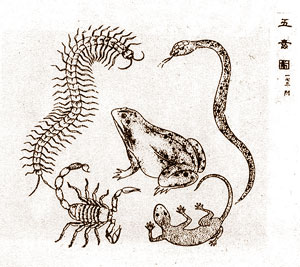
People think that May is the time when the five poisons (scorpion, snake, centipede, gecko and toad) appear, and people should use various methods to prevent the harm of the five poisons. Generally, a map of five poisons is posted in the house, five poisons are printed on red paper, and then five needles are stuck on the five poisons, that is, the poisons are stabbed to death and can no longer be rampant. This is a witchcraft legacy to ward off evil spirits. Folk also embroidered five poisons on clothes and decorated cakes with five poisons patterns, all of which meant expelling them.
The Dragon Boat Festival is also decorated with peach seals. Peach is an exorcism in folk custom, which originated from the myth of shentu and Yu Lei. It is engraved with peach, which also means to dispel the noise. "The History of Ritual in the Continued Han Dynasty": "Zhu Suo and the five-color peach seal are the door decorations to stop evil spirits." This is the origin of the ambiguous symbols and auspicious gourds of later generations. "Dream Liang Lu" Volume 3: "The sergeant and other scholars wrote the sentence" The Mid-Autumn Festival on May 5, the red mouth and white tongue are completely eliminated "at noon, which is the custom of the Song Dynasty. "The Year of Yanjing" also recorded: "Duanyang cut all kinds of gourds with colored paper for daily use and stuck them on the doorsill upside down to release toxic gas." This is the custom of the Qing Dynasty. Some still hang silk tassels and ribbons on paper gourds to look better, or cut out the shape of the five poisons in the gourds and stick them on the door, which also means that the gas of the five poisons will be exhausted. You are a "disaster-stricken gourd".
Up to now, there is still a custom of hanging mirrors on doors to avoid evil spirits. In the Tang Dynasty, a bronze mirror was cast in the heart of the Yangtze River in Yangzhou at noon on May 5 to pay tribute to the emperor, which was also meant to ward off evil spirits (see Supplement to the History of the Tang Dynasty). Therefore, later generations are more than hanging mirrors in front of the door to exorcise evil spirits.
Ma Dayong’s "On the Festival"
Editor: Shi Guanghui